

I’ve just finished reading two important write-ups done for Chips Communities United on the use of PFAS chemicals in the tech sector, one about their presence in wastewater outflows from a semiconductor manufacturing site in Washington state (Siegel 2026b) and another about their use for cooling of data centres (Siegel 2026a). There’s a lot going on in both of these write-ups, so I want to draw out a few key points from each of them.
Swedish ENGO ChemSec published an investigation into PFAS alternatives for electronics (Lay et al. 2023). Among the group’s findings were that alternatives do not appear to be available for at least some aspects of the following stages of semiconductor manufacturing: rinsing solutions, wafer thinning, vapour phase soldering, and protective coatings for some components (see also Jones and RINA Tech UK Limited (RINA) 2023). The incredibly small size of contemporary semiconductor structures are on the order of DNA. At that tiny magnitude the surface tension of fluids used to etch semiconductors can lead to what the industry calls pattern collapse. Pattern collapse, “happens when the surface tension of fluids used to etch structures into semiconductors generate enough force to bend or warp those structures. Such bending or warping leads to physical flaws in the resulting semiconductor (i.e., ‘pattern collapse’)” (https://electronicplanet.xyz/2024/10/22/what-is-insignificant-impact/).
PFAS use in data centres in what is coming to be called “two-phase immersion cooling” (or 2-PIC) is another issue of concern. There are multiple different ways that water can be used for such cooling e.g., evaporation, close loop recirculation, etc. there’s really no such thing as an average or standard data centre when it comes to cooling because of the variety of ways that water is used for data centre cooling and because of how those different ways intersect with local geographical conditions. What is becoming apparent, however, is that concerns about water availability and use by data centres are increasing the pressure on data centre companies to find alternative cooling strategies that reduce or even eliminate the use of water. 2-PIC is one such alternative.
The basics of 2-PIC involve immersing computer servers in fluid that can absorb the heat they generate and disperse it so that the servers remain within operational temperatures. Obviously, immersing something like a computer server means that whatever fluid is involved cannot conduct electricity (like water would). Hence, 2-PIC uses “hydrofluoroolefins (HFOs)” (Siegel 2026a), a subcategory of PFAS, as the fluid in which servers are submerged. According to industry sources, the benefits of HFO include significant savings of energy related to cooling, near elimination of water use (because close loop systems can be used), and lower global warming potential than other PFAS.
One way that 2-PIC is important to think about is that even according to industry advocates, “everything leaks” (Siegel 2026a; see McBee 2025 for original source). This idea that ‘everything leaks’ will be familiar to readers who know their discard studies literature (e.g., Gabrys 2009). In the context of 2-PIC seeing an industry advocate acknowledged this point out loud is significant. 2-PIC systems are supposed to be closed loops. Losses from such systems can be tiny (assuming normal operating conditions), but they aren’t zero. According to the write-up for CCU, industry claims that losses of the coolant from such systems might account for 0.7% per year. A loss rate of less than one percent per year might not sound like much, but it’s important to remember that we are talking about the magnitude of industrial systems. Here I will quote at some length:
“Chemours [a manufacturer of PFAS] explains that the typical 2-PIC tank contains 1270 liters of Opteon [the commercial name of the HFO coolant], enough to expand to over 300,000 liters of fluorinated gas. A typical hyperscale data hall contains hundreds of tanks.” (Siegel 2026a)
There’s no straightforward way to go from a volumetric measurement of gas, in this case litres, to a measure of its mass unless you know some details about the gas in question and, when it comes to HFO, I have not been able to find such specifics yet. That said, the important point understand here is that even if losses from the system are small (say, less than one percent a year) that does not mean that the resulting negative consequences are small as well. For example, while HFO has a global warming potential (GWP) of 10 (meaning it is 10 times more powerful than carbon dioxide), once in the atmosphere it can break down into other forms of PFAS, including trifluoroacetic acid (TFA). TFA can undergo its own chemical changes under some atmospheric conditions that transform it into a very powerful greenhouse gas with a GWP between 3,500-14,000 times greater than carbon dioxide (see Table 10 of Salierno 2024). The consequences of this chemical change are important to emphasize since one of the ‘selling points’ of HFO as a data centre coolant is that it has a relatively low GWP of 10. But, when it gets into the atmosphere – since everything leaks – it’s potential for a global warming increases massively as it breaks down into other chemical arrangements in the atmosphere.
That’s the climate emergency side of PFAS, what about concerns related to toxicology? Well, HFO is a sub category of the broader family of PFAS. As I’ve written about here (see the section on “Water Quality”) the toxicology of PFAS is a major source of scientific and industry controversy. To contextualize the stakes of that controversy consider that a recently published ‘Perspective’ in the journal Environmental Science & Technology points out that defining safe planetary boundaries for novel entities, like synthetic chemicals such as PFAS, based on the principle of zero such entities that have not been fully characterized for their effects, “is unattainable” (Jahnke et al. 2026, 1). It’s a bit difficult to adequately convey the meaning what these toxicologists are stating so bluntly, but they are not the first to do so. As Brian Wynne (1987) pointed out decades ago there are literally so many chemicals already in use that have not been fully characterized for their actual or potential harms that it is actually impossible to do so. We will never be able to fully know what we don’t know about the actual or potential toxicity of the myriad chemicals already in use.
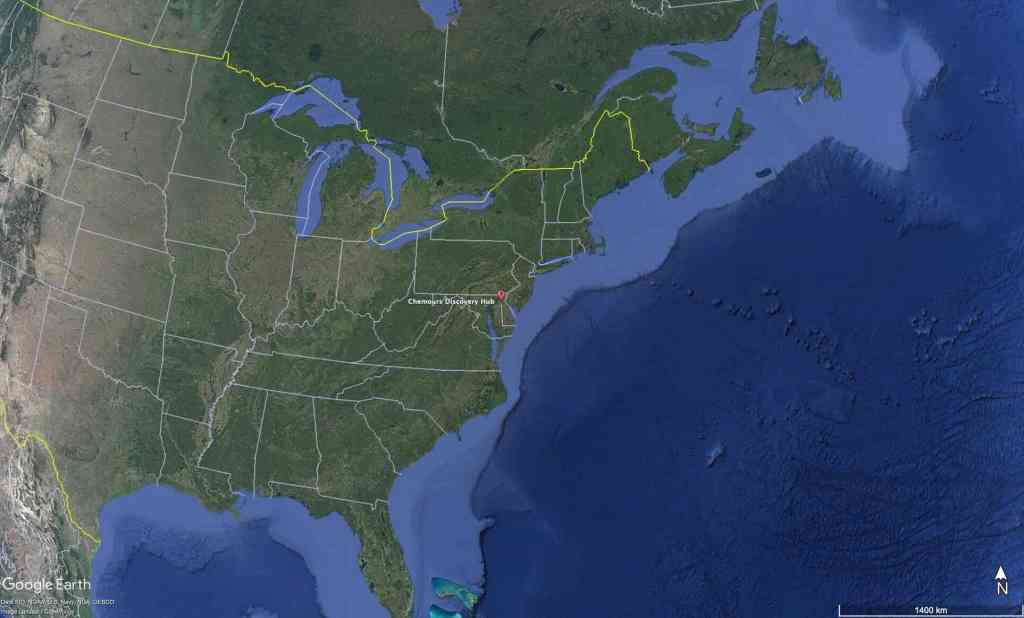
It’s important to consider the implications of both of global warming potential and toxicity of PFAS in general and specific examples of them such as TFA and HFO. One way to do so is to consider the issue of magnitude. Magnitude is about the extent of something. Juxtaposing the GWP of HFO (10) with TFA (3,500-14,000) highlights the importance of thinking in terms of orders of magnitude. One can read those numbers but it can be hard to really grasp just how different these GWP measures are from one another. Here’s a way to visualize it:

The top image shows a US-based Chemours facility at 201 Discovery Blvd., Newark, DE. Notice the bar scale toward the bottom right of this image shows what 1 km looks like. Meanwhile, the bottom image shows the same Chemours facility, but at a 1000 times different scale (i.e., three orders of magnitude different). It’s one thing to read that HFO has a GWP of 10 and TFA has a GWP more than 1000 times more powerful. It’s another thing to see a visual analogy that shows the same differences of magnitude but in a different form. The analogy helps frame the shape of the problems in play in ways that perhaps mere numbers alone may not convey as well.
As a class of chemicals, PFAS raise similar issues of magnitude when it comes to just how many chemicals are members of the class. A recent discussion of the social life of PFAS by two anthropologists claims that PFAS are comprised of “several thousand” compounds (Renfrew and Pearson 2021, 146). Meanwhile, according to professors of environmental chemistry and biotechnology there are over 7 million PFAS chemicals (Schymanski and Bolton 2023) (see also: https://pubchem.ncbi.nlm.nih.gov/classification/#hid=120). Once again, these differences in numbers are about three orders of magnitude, the same you see in the images of the Chemours facility above.
If the concern is about the toxicity of PFAS in general or specific members of the class, like HFO or TFA then things get… weird. PFAS represent a class of synthetic chemical compounds not amenable to typical hazard and risk assessment approaches (Wollin et al. 2023). We know PFAS are long lasting (hence their popular designation as ‘forever chemicals’). We also know that PFAS are ubiquitous, although unevenly distributed geographically. They are both forever and everywhere, but not equally so. Within the limited information about the toxic consequences of PFAS there is also evidence that at least some instances of these compounds represent linear non-thresholds of impact, that is, able to enact harm on contact. Knowledge of PFAS gets extremely sketchy beyond these broad characteristics. It is quite possible that some sub-classes of PFAS have other characteristic dose response relationship to toxicity (see discussion of toxicological curves in Figure 2.1 of Liboiron 2021, 93) (see also, “It is clear that harms associated with PFASs vary wildly…” at https://electronicplanet.xyz/2024/10/22/what-is-insignificant-impact/ ). For example, US and EU regulators disagree on whether TFA should be classified as a toxicant. Given the different ways that PFAS compounds behave with respect to dose response curves, it is unlikely that there will ever be a ‘bright line’ beyond which everyone agrees PFAS in general, or specific types thereof, are toxic.
Closing the “data gaps” necessary to prioritize the huge number of PFAS compounds into meaningful categories for regulation premised on classic hazard and risk assessment approaches “would take up to centuries” (Wollin et al. 2023, 3305). The very notion of ‘data gaps’ about numbers of PFAS and their toxicology under such conditions seem euphemistic at best.
A recent assessment of the costs to remove PFAS from the environment given current rates of emission? $20-7,000 trillion (with a ‘T’) dollars (more than total global GDP) (Ling 2024). This is an absurd situation–and such situations are easy pickings for industries and their lobbyists to wield as reasons to do nothing.
Chemical companies manufacture PFAS but they also manufacture doubt and ignorance and use them tactically to deny, deflect, and defer responsibility and regulation (Oreskes and Conway 2010) for the chemicals they have manufactured and which have been found toxic to the people, places, and things with which they become entangled. The use of such tactics were disclosed in a class action lawsuit settled in 2015 against DuPont (Bilott and Shroder 2019). Consequently, critical analyses of PFAS and their social lives (Renfrew and Pearson 2021) must be cognizant of the politics of knowledge, that is, struggles pertaining to power over the ability to know the toxicities of PFAS as well as over the deliberately manufactured ignorance, or agnotology (Proctor and Schiebinger 2008), of those toxicities. Since corporate interests deliberately manufacture and mobilize ignorance about PFAS in order to avoid liability, critical analysts need to do more than simply gesture to differences between uncertainty and indeterminacy since it is exactly those concepts that can be weaponized by those seeking to dodge their responsibility for toxic harm.
So, what to do? Regulation, litigation, yes (e.g., New York v. 3M 2026; Uebelacker 2026). But of what and how? Even if PFAS were to be magically regulated well tomorrow, their clean up will never be complete barring the advent of science fictional technical interventions not yet even dreamed of. STS scholar Annemarie Mol writes, “it may help to call ‘what to do?’ a political question. The term politics resonates openness, indeterminacy. It helps to underline that the question ‘what to do’ can be closed neither by facts nor arguments.” (see also here: https://electronicplanet.xyz/2024/10/22/what-is-insignificant-impact/).
Toxicologists and others have suggested some responses given these conditions. here are some examples:
- Shift from risk analysis and towards alternative analysis frameworks for assessing PFAS (O’Brien 1993). As Liboiron shows, the presumption of the approriateness of risk analysis is “so strong that even in the case of carcinogens and radiation, policy uses risk analysis that allows for a certain amount of population death (or acceptable loss)” (Liboiron 2021, 92 footnote 46). Risk analysis approaches tend to frame the problem of toxicology in terms of questions about thresholds e.g., at what amount is harm experienced from a given chemical? Alternatives assessments start from a different framing by asking questions such as what substitutes might there be for a given chemical? If there are no substitutes, what is the least amount of a given chemical that can be used for a given purpose? Abroad issue with risk analysis approaches is that they are premised on threshold theories of harm. But as discussed above regarding the variability of dose responses for PFAS the very idea of a ‘threshold’ may be irrelevant. Some alternatives to some PFAS do exist for some applications, but these alternatives are far from unproblematic. As toxicologist point out, not enough is known about alternatives to be certain that they do not bring with them their own equal or even more severe toxic consequences. Moreover, even if regulatory restrictions are put in place today these will do nothing to mitigate or reduce PFAS which have already been released into the environment and will continue to be released into the environment as the innumerable products into which they have been incorporated degrade ever so slowly over geologic time (even as the PFAS compounds themselves may never break down).
- Relatedly, shift from a regulatory approach premised on the permission to pollute to an approach premised on the responsibility to mitigate and eliminate harms.
- Enact appropriate regulation that would require PFAS manufacturers to conduct more thorough testing, mandate that chemical structures be made public, and require the use of safe(r) non-persistent alternatives. Make chemical manufacturers disclose the toxicology data they already produce in-house available for public scientific audit. As Scheringer et al. note, (2014) it is costly for publicly funded toxicological research to produce the data needed to demonstrate harm from these chemicals (see also Blum et al. 2015; Ritscher et al. 2018). Yet, as in so many industrial situations, companies are permitted to externalize the costs and risks of toxicology to broader society while simultaneously those companies are permitted to privatize the money they collect from sales of their products as their profit. Yes, of course, if companies were required to publicly disclose their in-house toxicology data they would would cry about commercial secrecy. But let’s not forget that their profits depend on the permission to pollute the rest of us.
The points above are angles of attack with direct relevance for PFAS toxicology concerns. However, the power of companies to obtain the permission to pollute, to claim trade secrecy to avoid disclosure of toxicology data they produce in-house, etc. also comes from aspects of the policy and regulatory environment that have no direct relationship with the issue of chemical toxicants per se. Such aspects include those which permit and incentivize corporate behaviour toward monopoly and growth at all costs. Dispersing such corporate power by, for example, repealing Citizens United, carrying out robust anti-trust enforcement, and repealing the legalization of stock buybacks would reduce the power of corporations to shape the political-economic conditions in their favour (e.g., through lobbying, political donations, etc.). These angles of attack don’t directly address chemical toxicants and may involve heavier lifts and/or different approaches than those more narrowly targeted at toxicants. But, these indirect angles of attack also potentially enlarge the coalition–and, thus, the power – – of interests that might be organized to work together and get things done. That is not to suggest such organizing would be easy. On the other hand, making major political change is not easy, nor ever finished.
I’m reminded of one of Cory Doctorow’s recent books in which he makes the case that:
“If we someday triumph over labor exploitation, gender discrimination and violence, colonialism and racism, and snatch a habitable planet from the jaws of extractive capitalism, it will be thanks to technologically enabled organizing. From street protests to mutual aid funds, from letter-writing to organizing sit-ins, from blockades to strikes, we need digital networks to prosecute our struggle.” (Doctorow 2023, 25 emphasis in the original).
I think I agree with Doctorow’s point, broadly speaking. And, if so, I also cannot simply wave away the toxicological implications of my agreement. There may be substitutes and alternatives for PFAS use for data centre cooling, but it appears that there are no unproblematic substitutes on the horizon for the use of at least some members of the PFAS family in some specific phases of semiconductor manufacturing. Semiconductors are the foundation of any digital technologies. Given that, there is no getting around at least some PFAS pollution, at least for the foreseeable future. Remember: everything leaks, so if I agree with Doctorow’s position then I am also conceding that some amount of pollution is going to occur. As always, the key questions remain: For whom? Where? When? Under what conditions? And, consequently, what is to be done? These are questions with no final answers on the horizon, but that is no excuse for not trying to offer at least provisionally acceptable responses to them.
Works Cited
Bilott, Robert, and Tom Shroder. 2019. Exposure: Poisoned Water, Corporate Greed, and One Lawyer’s Twenty-Year Battle against Dupont. First atria books hardcover edition. Atria Books.
Blum, Arlene, Simona A. Balan, Martin Scheringer, et al. 2015. “The Madrid Statement on Poly- and Perfluoroalkyl Substances (PFASs).” Environmental Health Perspectives 123 (5): A107–11. https://doi.org/10.1289/ehp.1509934.
Doctorow, Cory. 2023. The Internet Con: How to Seize the Means of Computation. Verso.
Gabrys, Jennifer. 2009. “Sink: The Dirt of Systems.” Environment and Planning D: Society and Space 27: 666–81.
Jahnke, Annika, Yuge Bai, Werner Brack, et al. 2026. “Planetary Boundary for Novel Entities: Time for a Reboot.” Environmental Science & Technology, ahead of print, July 2. https://doi.org/10.1021/acs.est.6c03044.
Jones, Emily Tyrwhitt and RINA Tech UK Limited (RINA). 2023. The Impact of a Potential PFAS Restriction on the Semiconductor Sector. Nos. 2022-0737 Rev. 0. SIA PFAS Consortium.
Lay, Dean, Ian Keyte, Scott Tiscione, and Julius Kreissig. 2023. Check Your Tech: A Guide to PFAS in Electronics. ChemSec. https://chemsec.org/app/uploads/2023/04/Check-your-Tech_230420.pdf.
Liboiron, Max. 2021. Pollution Is Colonialism. Duke University Press.
Ling, A. L. 2024. “Estimated Scale of Costs to Remove PFAS from the Environment at Current Emission Rates.” Science of the Total Environment 918. Scopus. https://doi.org/10.1016/j.scitotenv.2024.170647.
McBee, Jeff. 2025. “How to Determine Leak Rates in Data Center Cooling Systems.” May 21. https://www.cincinnati-test.com/blog/leak-rates-data-center-cooling-systems.
New York v. 3M (Supreme Court of the State of New York July 9, 2026). https://www.courthousenews.com/wp-content/uploads/2026/07/new-york-lawsuit-forever-chemicals-drinking-water.pdf.
O’Brien, Mary H. 1993. “Being a Scientist Means Taking Sides.” BioScience 43 (10): 706–8. https://doi.org/10.2307/1312342.
Oreskes, Naomi, and Erik M. Conway. 2010. Merchants of Doubt: How a Handful of Scientists Obscured the Truth on Issues from Tobacco Smoke to Global Warming. Bloomsbury.
Proctor, Robert N., and Londa L. Schiebinger. 2008. Agnotology: The Making and Unmaking of Ignorance. Stanford University press.
Renfrew, Daniel, and Thomas W. Pearson. 2021. “The Social Life of the ‘Forever Chemical’: PFAS Pollution Legacies and Toxic Events.” Environment and Society. Environment and Society 12 (1): 146–63. https://doi.org/10.3167/ares.2021.120109.
Ritscher, Amélie, Zhanyun Wang, Martin Scheringer, et al. 2018. “Zürich Statement on Future Actions on Per- and Polyfluoroalkyl Substances (PFASs).” Environmental Health Perspectives 126 (8): 084502. https://doi.org/10.1289/EHP4158.
Salierno, Gabriel. 2024. “On the Chemical Pathways Influencing the Effective Global Warming Potential of Commercial Hydrofluoroolefin Gases.” ChemSusChem 17 (17): e202400280. https://doi.org/10.1002/cssc.202400280.
Scheringer, Martin, Xenia Trier, Ian T. Cousins, et al. 2014. “Helsingør Statement on Poly- and Perfluorinated Alkyl Substances (PFASs).” Chemosphere 114 (November): 337–39. https://doi.org/10.1016/j.chemosphere.2014.05.044.
Schymanski, Emma, and Evan Bolton. 2023. “Are There Really 6 Million PFAS in PubChem?” March 22. https://doi.org/10.5281/zenodo.7756622.
Siegel, Lenny. 2026a. “Forever Chemicals Cool Data Centers.” CHIPS Communities United, June 29. https://chipscommunitiesunited.org/news/forever-chemicals-cool-data-centers/.
Siegel, Lenny. 2026b. “Response to Washington Department of Ecology’s Draft Waste Discharge Permit for TSMC Washington.” CHIPS Communities United, July 7. https://chipscommunitiesunited.org/news/comments-on-state-waste-discharge-for-tsmc-washington/.
Uebelacker, Erik. 2026. “New York Sues 3M, DuPont over ‘Forever Chemicals’ in Drinking Water.” Courts. Courthouse News Service, July 9. https://courthousenews.com/new-york-sues-3m-dupont-over-forever-chemicals-in-drinking-water.
Wollin, Klaus-Michael, Monika Batke, Georg Damm, et al. 2023. “PFASs–Restriction Proposal Commentary on ECHA’s Annex XV Restriction Report, Proposal for a Restriction, March 2023.” Archives of Toxicology 97 (12): 3305–12. https://doi.org/10.1007/s00204-023-03597-y.
Wynne, Brian. 1987. Risk Management and Hazardous Waste: Implementation and the Dialectics of Credibility. Springer London, Limited.
 Electronic Planet Research Lab
You must be logged in to post a comment.