
This is a text version of a keynote talk I was invited to give at an international symposium at York University in April 2026. I have included images of my slides that accompanied my talk. My talk was about thinking through what counts as ‘waste’, what counts as ‘work’ in what the symposium’s organizers called the ‘new global politics of disposability’.
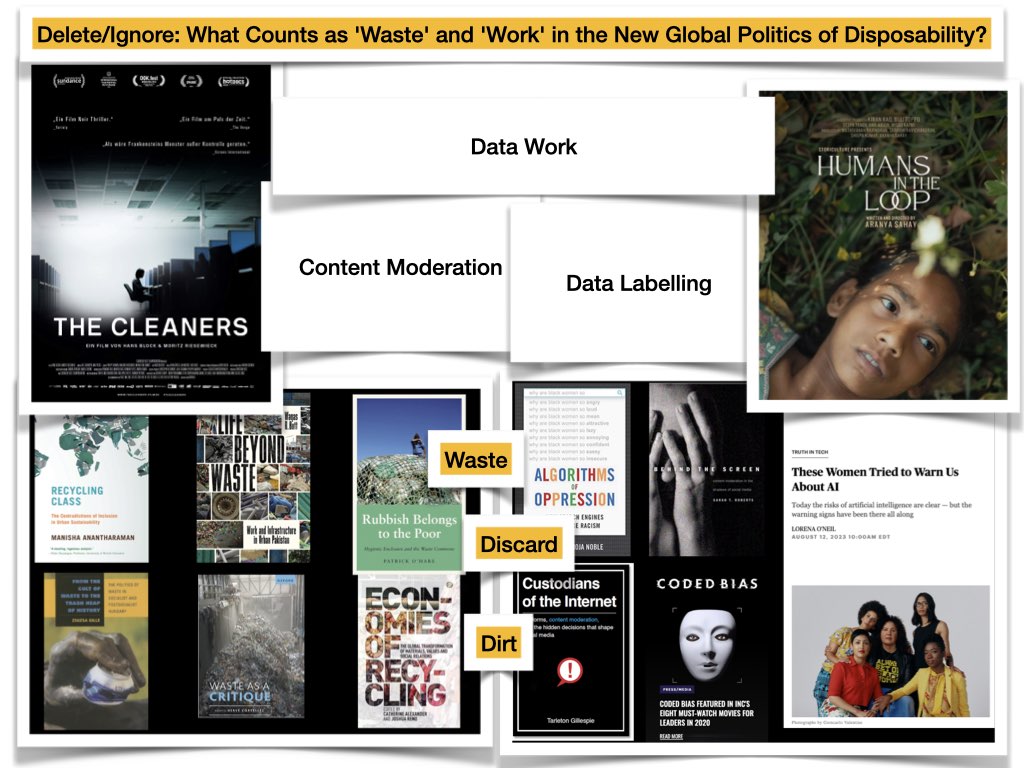
The premise of my talk is to examine three linked questions about what the conveners of this symposium have called the ‘new global politics of disposability’. Those three questions are:
1/ What counts as “waste”and “work” in this new global politics?
2/ Who are these workers and where do they do their work?
3/ What is, or might be, “new” about the new global politics of disposability?
To provide some at least provisional answers to these questions I’m going to offer an analytical story that weaves together several different conceptual and empirical threads. Empirically, most of what I have to say today will draw on interpretive gleanings of two films. One is a documentary released in 2018 called “The Cleaners”. The other is a realist drama called “Humans in the Loop”, released in 2025.
Both of these films depict what in some recent scholarly research and journalism is being called “data work” or, sometimes, “ghost work”. I will have much more to say about the details of this kind of work as I move further into my presentation, so here let me just briefly suggest that “data work” is a kind of over arching term that refers to specific kinds of labor, crucial to the so-called digital economy. As an umbrella term data of work can refer to specific activities like moderation and data labeling. Now, both of these have specificities, that I will get into as I move along, but it is perhaps important to note that the distinctions between these two types of data work are not necessarily clear cut.
If you have heard of content moderation, it is probably within a context of discussions about the invisible labour behind social media platforms. Data labeling, on the other hand, is typically more often associated with so-called artificial intelligence. Yet, as we will see, there’s quite a bit of overlap between the two in terms of labour conditions and the geographies of labour associated with that work.
So much for an overview of my empirical story. Conceptually, I want to make some connections between the meanings of associated terms of ‘waste’, dirt’, and ‘work’ in the research of many of us in this room (including my own); and I want to build on those connections to suggest how thinking about discarding might be analytically useful for broadening what might count as waste, work, and the new global politics of disposability.
When “computers” were people
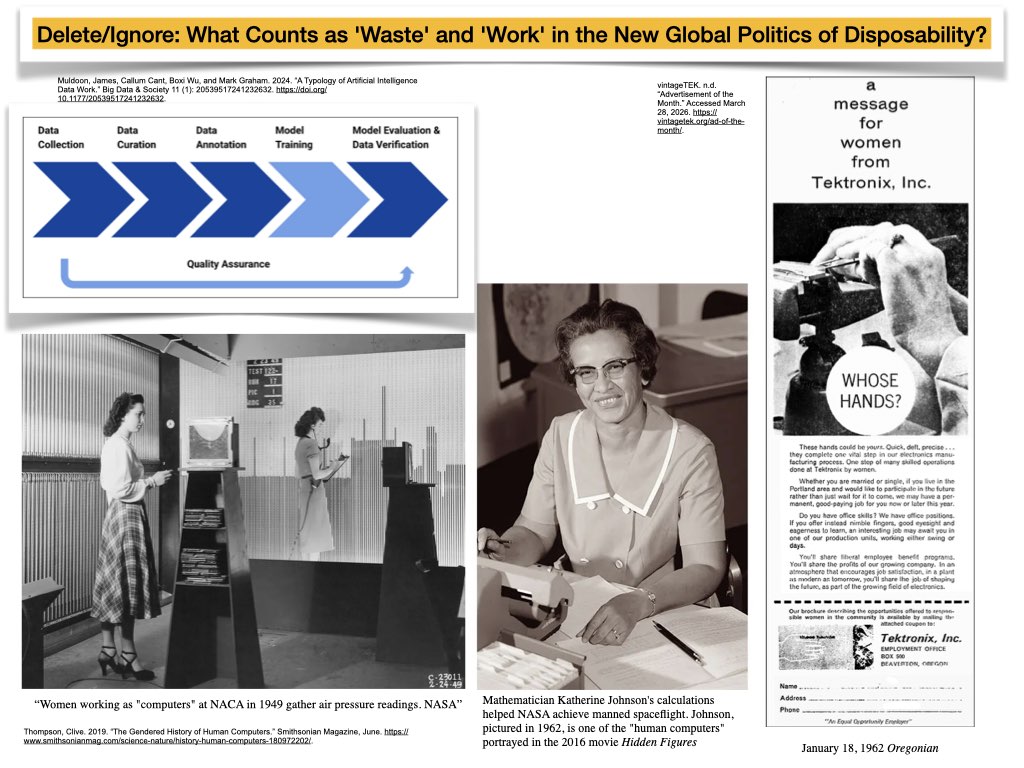
What are the stakes of presuming that ‘data work’ is new? Muldoon et al (2024) offer readers a useful typology of data work as it pertains to contemporary artificial intelligence models.
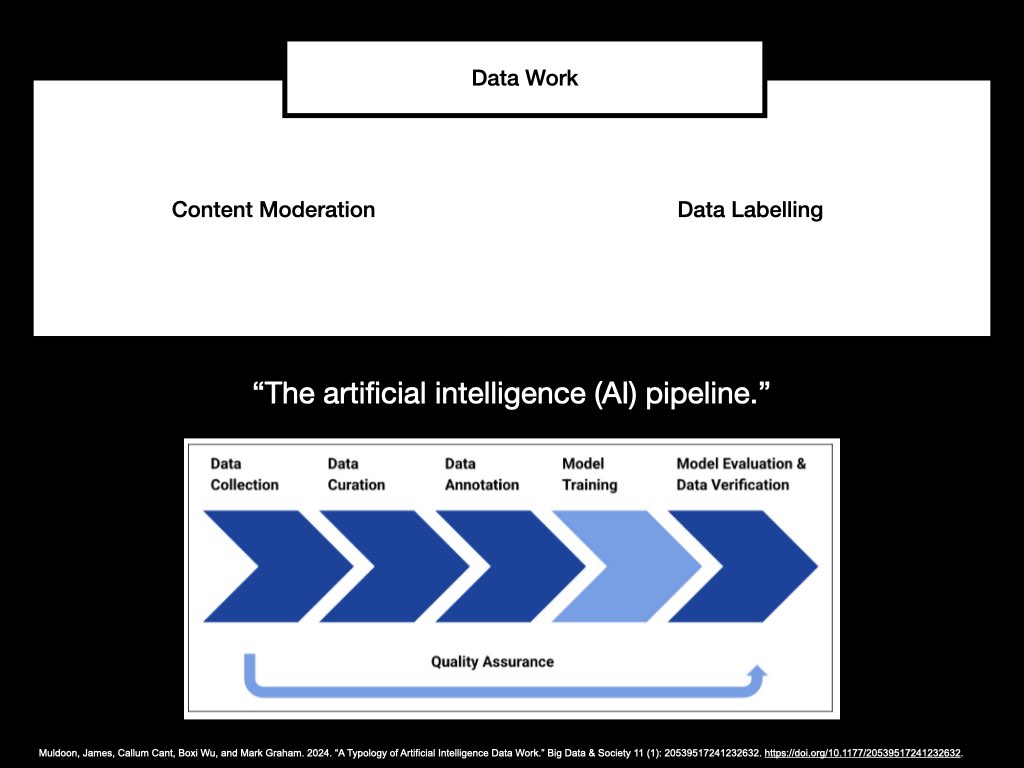
And, while I doubt that these authors would deny the historical linkages between contemporary forms of data work and it’s antecedence, it’s important I think to remind ourselves that a characteristic of what these authors are calling the “artificial intelligence data pipeline” is that human labour is evident throughout it – from data collection, to curation, annotation, training, evaluation, and verification. None of the steps along the way, nor the constant need for quality assurance, can be fully automated. And of course, a variety of social positionings–gender, class, race, etc.–are relevant for understanding the labour and the labourers doing data work as well as the forms of power they are subject to and the power that they themselves can wield.
And here I will just flag–if it needs saying–that it would be overly simplistic to treat the people who do data work merely as victims of more powerful people and institutions. As we will see from the films and associated material I will discuss in a moment it is important to recognize that power is patchy, distributed, and not necessarily coherent. People as data workers have important forms of agency and can, indeed, wield their own forms of power for both individual and collective ends–as we will see.
Criti-hype and ‘AI’ as normal technology
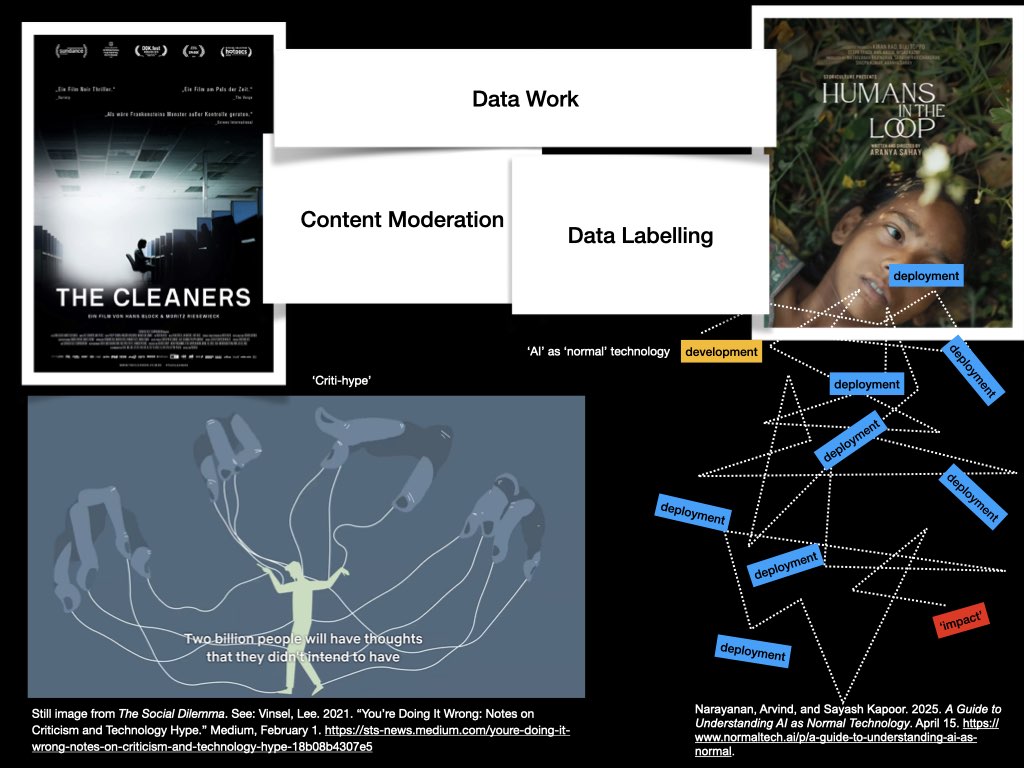
Here I will introduce to analytically useful concepts to begin thinking about the depictions of data work seen in the two films. The first concept is what historian of technology Lee Vinsel (2026) calls ‘criti-hype’. For Vinsel, ‘criti-hype’ describes analyses that accept, more or less at face value, dramatic self-serving claims about large scale social disruption that device X, Y, or Z is claimed will wreak on the world, but that then turns that hype into criticism, e.g., the supposed ability of social media to directly control peoples behavior. Vinsel’s point is not that social media platforms or smart phones have no influence on peoples behavior. Instead, he shows us why it is crucial to not mistake boosterist marketing claims that ultimately benefit the companies making them for the actual ability of those apps or devices to work as those claims suggest they can.
Did Facebook/Meta run a non-consensual experiment on users of its platform to examine the effects of different content on users emotional responses? Yes. Were there measurable effects? Yes. But what gets left out too often in the reporting about these infamous studies is just how small the measured effects were: for people enrolled in Facebook’s study–non-consensually–and who had the negativity of the content of their newsfeeds increased, their subsequent status updates were found to contain more negative words. “Emotional contagion”, as Facebook’s data scientists put it, was achieved (Meta (Facebook) 2012). But the effect was very small, approximately 0.01 percent increase in negative status updates compared to a control group (see Figure 1, Kramer et al. 2014).
In a second study Facebook data scientists managed to get 280,000 people out of a total of 61 million across the entire United States to vote — a total effect size of about 0.4 percent (Bond et al. 2012; Doctorow 2022). These are tiny effects–not nothing effects – but it is hardly a ‘mind control ray’, as tech journalist and activist Cory Doctorow encourages us to realize (Doctorow 2022); nor is it a technological puppetmaster with complete control over 2 billion people who “will have thoughts that they didn’t intend to have”.
What Vinsel is getting at is that we do ourselves no favours when we take marketing claims and turn them into insufficiently examined critical anxieties. Not only will we misunderstand how devices actually work, we risk ignoring or missing whole swaths of substantial harms caused by these devices, yet which are incurred less by users and more by those behind the screens.
A more grounded approach to the effects of technologies, such as AI, is also advocated for by Arvind Narayanan and Sayash Kapoor, both computer scientists at Princeton, who have recently argued for understanding, artificial intelligence as what they call “normal technology” (Narayanan and Kapoor 2025). Briefly, what they mean by AI as normal technology is that there is a long, indeterminant, and unpredictable chain of causation between a given device’s development – – in this case AI – – and what could be understood as it’s “impact” on society. What is key, these authors argue, is not the development or capability of a given device at a given time but its actual deployment into real social situations outside the lab or the marketing department. Similar to Vinsel’s warnings about criti-hype, Narayanan and Kapoor encourage us as analysts to pay attention to benefits and harms as they are actually experienced by the full range of people, places, and things in situations where the devices are actually deployed. Although these authors are not explicit about it, their emphasis on the importance of deployment can quite easily be understood to apply to data work such as content moderation and data labelling. It is precisely the portrayal of people, places, and things at various sites of deployment that the film Humans in the Loop does so well to help us understand AI as, indeed, normal technology.
The Cleaners or a personal epiphany about waste, dirt, and discard
Back about 1000 years ago, sometime between 2018 and 2019, I was sitting in an airplane. I don’t remember where I was going to or where I was coming from, but I do remember that I decided to watch a movie. By coincidence I chose a documentary called, The Cleaners. It was dark. It was grim. It was also totally fascinating. Seeing it, I suddenly realized that I needed to think much more precisely about how I had been approaching important concepts in my research to that point: waste, dirt, and discard.
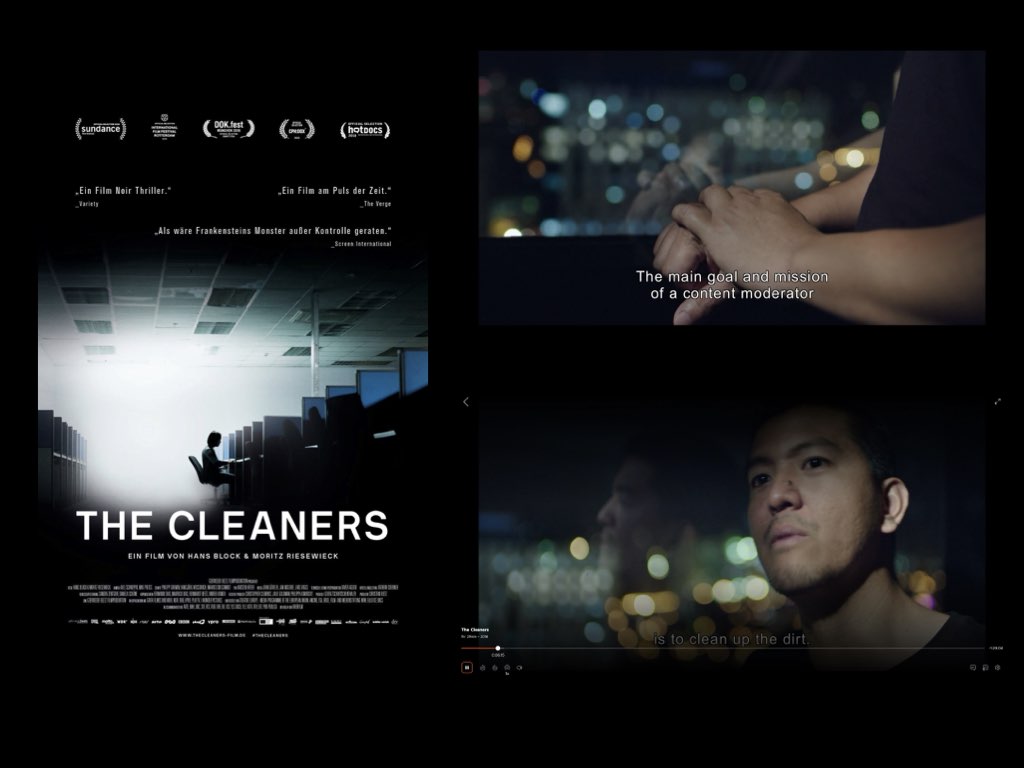
The Cleaners is a documentary but filmed like a noir thriller. Most of what is shown involves interviews with semi-anonymous content moderators based in the Philippines. Content moderation – for those not already familiar with it – is a type of data work, particularly associated with the workings of social media platforms. The job of a content moderator essentially boils down to making decisions to delete or to ignore posts made to social media platforms based on the terms of service of those platforms. Essentially, user posts are funneled through a data pipeline of content moderation decisions that precede a given post actually appearing on a given platform. That pipeline funnels the data that constitutes a given post to whatever content moderation systems are given platform uses. Those systems are an admixture of automation and human labor. It is important to understand that no platform has yet been able to fully automate content moderation. There are reasons for this that I will get into, but suffice it to say that the legal terms of service and what platform companies sometimes call ‘community guidelines’ require very subtle judgements to make what are deemed the “right” decisions. As I have written elsewhere,
“Content moderation guidelines are astonishingly ad hoc systems that continue to stymie attempts at automation. While social media companies continually tout the role of algorithms for content moderation, much of the work comes down to a human being sitting at a screen and making ignore/delete decisions (Chen 2014). Early on, around 2008, the guidelines at Facebook were a one-page document that said little more than, ‘nudity is bad, so is Hitler, and if it [a Facebook post] makes you [the moderator] feel bad, take it down’ (Radio Lab 2018, 00:11:15)” (Lepawsky 2019).
But as more and more breakdowns in the early content moderation guidelines, like those of Facebook encountered, a “… search for ever-finer categorizations as a system to control objectionable content leads to ever more failures of the system to contain and control. Arguably, these failures occur when a specific system and its peculiar particulars are mistaken for a universal.” (Lepawsky 2019)
Getting me to this understanding of content moderation was The Cleaners and this scene in particular roughly six minutes into the film. In that scene, one of the content moderators that we see frequently in the next hour and a half of the film states plainly, “the main goal and mission of a content moderator is to clean up the dirt.”
Now, I know my Mary Douglas (1966). Her work taught me that, “where there is dirt there is system” (Douglas 1966, 36). Her work also taught me that there is an important difference between dirt and rubbish (aka ‘waste’). In any given system, “rubbish is not dangerous. It does not even create ambiguous perceptions since it clearly belongs in a defined place, a rubbish heap of one kind or another.” (Douglas 1966, 161; Liboiron 2019). Waste is not matter out of place, dirt is. Unlike waste, dirt in Douglas’s framework is something that does represent danger because whatever it is it contravenes this or that ordering system. That contravention is an existential threat to that ordering system because it reveals that ordering system to be particular, provincial, not everywhere, not always. As such, dirt raises a fundamental challenge to a given status quo. Dirt speaks. It says to the status quo, and those who benefit from it, “things could be otherwise”.
Seeing the content moderator depicted here essentially make that same point, but in a very different context from waste picking or kerbside recycling, clarified for me that I needed to think much more carefully about waste, dirt, and discard. His words challenged me to think about what the system was from which this “dirt” needed to be cleaned up and what that meant. The scene also helped me realize that there were all sorts of things other than what you might find in a trash bin, a materials recycling facility, a landfill, or a scrap heap. I had to start thinking about social media posts and their content – racism, sexism, pornography, violence – as things constituting dirt in particular ordering systems.
Thinking through what I saw in The Cleaners prompted me to write a post forthe Discard Studies blog and those ideas eventually made their way into the book Max and I wrote together.
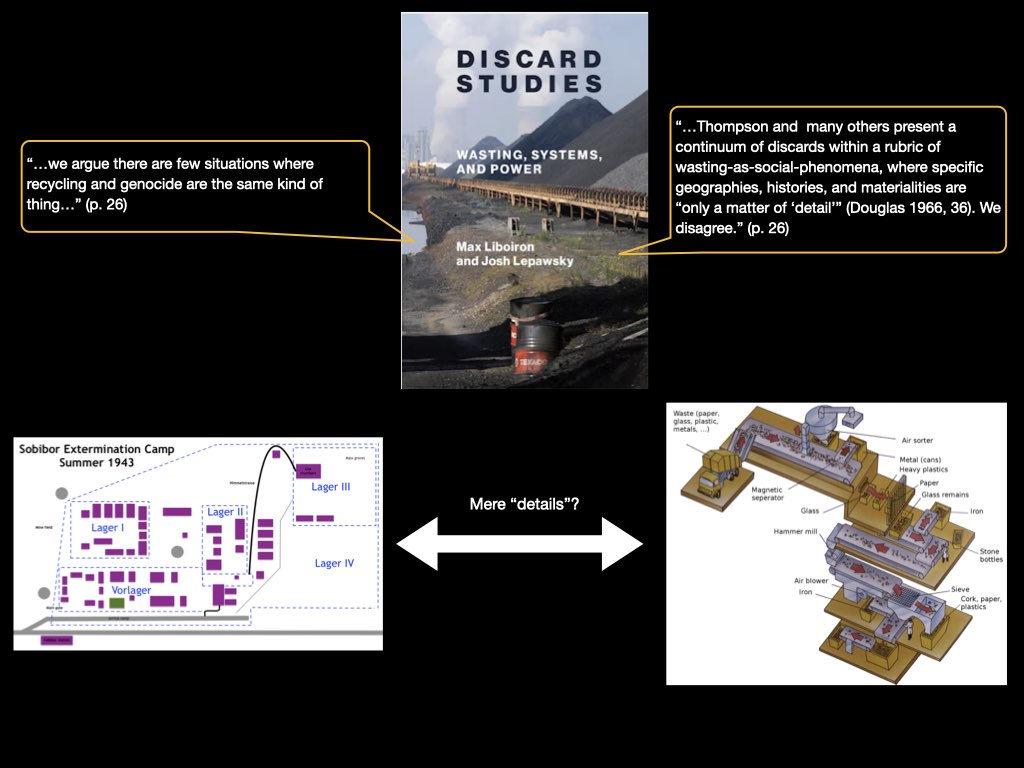
In the book, we explicitly draw on ideas about rubbish, waste, and dirt as articulated by Douglas, also Thompson (1979), and while we do find those ideas analytically powerful, we found ourselves, unable to abide Douglas’s argument that, “our ideas of dirt also express symbolic systems and that the difference between pollution behaviour in one part of the world and another is only a matter of detail” (Douglas 1966, 36). Yes, there are similarities between Nazi extermination camps and materials recycling facilities. Both involve logistics that sort, separate, classify, repurpose, and incinerate. But Max and I were unable to accept an argument that differences between these two systems are merely matters of detail.
All Systems Must Discard
What we came to understand through authors, such as Douglas and Thompson was that all systems must rid themselves of things so as to maintain the ordering that makes them. In this sense, discard studies is a theory of systems but not systems theory. Here, ‘system’ is used in a deliberately loose sense to connote some form of ordering or another. Inevitably, there are some things that do not fit that ordering, and, as such, are some kind of existential threat to that ordering system. ‘Thing’, too, is being used in a deliberately loose sense. It might refer to a person, a place, or something else – we might insert other more theoretically abstract concepts like actant or non-human other – but the key here is that whatever we are talking about falls into the category of dirt because it does not fit for one reason or another and is, as such, a threat to the continuation of that system so ordered.
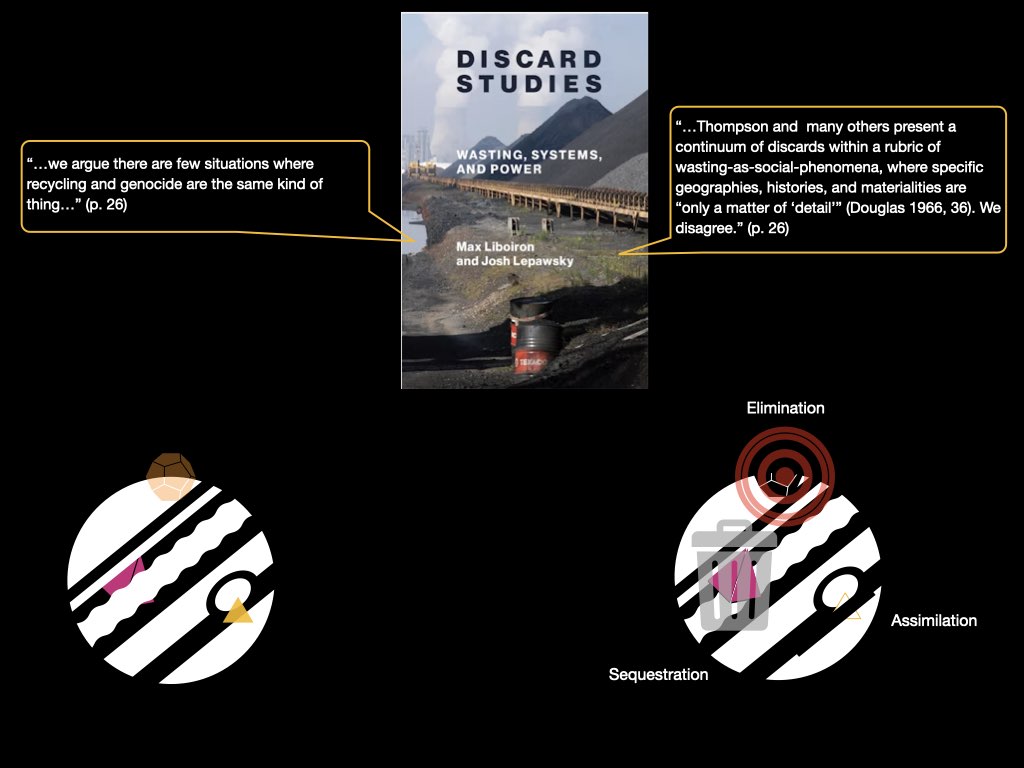
A system confronted with people, places, or things that don’t fit has a variety of options for dealing with them in a bid to maintain the coherence of its ordering. It might sequester them in a bin or a container of some kind. It may attempt to assimilate them. Or, it may find a way to eliminate them. We also argue that the assertion of power to sequester, eliminate, or assimilate is not inherently ‘bad’ or oppressive. It can be, of course, but it is not necessarily so. In Discard Studies we offer a theory of power that is, “about how some things are maintained, counted as good, become normal, and thus become uneventful while others struggle for recognition, are debated, or are discarded” (Liboiron and Lepawsky 2022, 62). No doubt all of us can think of a few examples of discarding that result in our own abilities to subsist and persist individually or collectively and are, in that sense, ‘good’.
The basics of content moderator pay and working conditions
Typical working relationships for content moderation involve third-party contractors. Thus, although the people actually doing the work of content moderation are sifting through social media platform feeds for companies, such as Facebook or Twitter, they do not actually work for those companies. Contracting and outsourcing are, of course, common techniques used by firms to externalize – discard, if you will – costs from their ledger onto someone else’s. The use of third-party contractors has the additional benefit to firms that use them of creating a legal firebreak between their operations and the working conditions experienced by those employed by third-party contractors. Data that are available for wages and salaries show stark differences between the pay for content moderators compared to salaried employees at firms like Facebook.
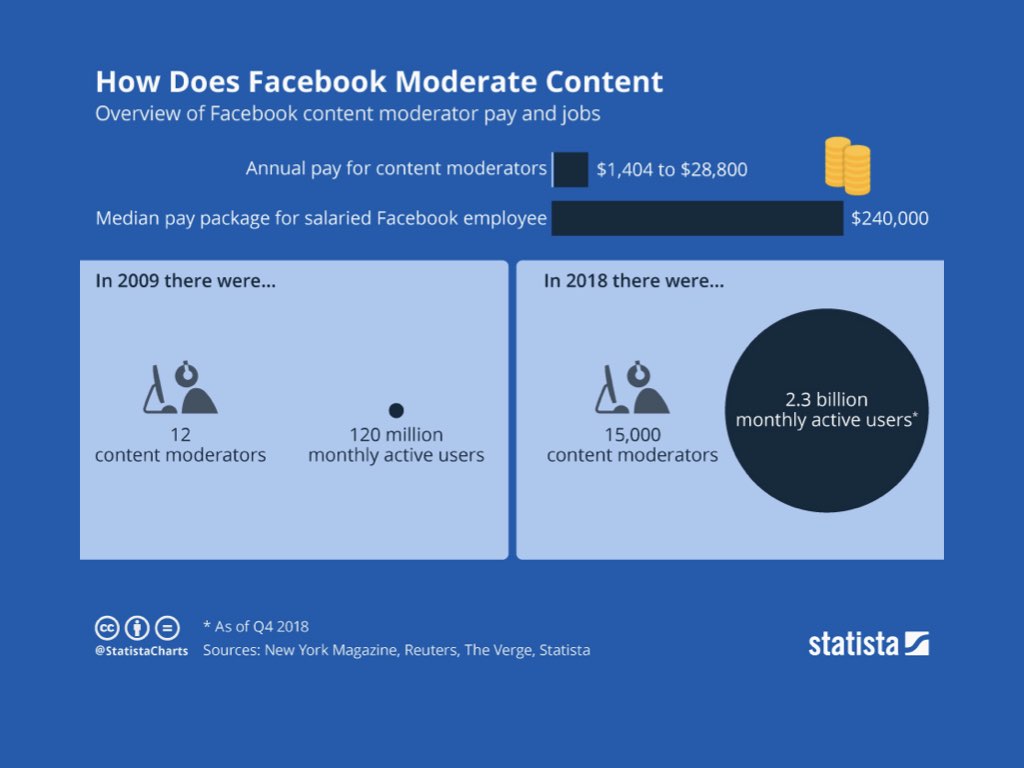
Other factors contribute to negative aspects of working conditions in content moderation. As contractors, content moderators are typically less protected by labour law when it comes to scheduling shifts, benefits such as sick leave, or dismissal. Differentials of power in the employment relationship are tilted towards managers and owners of the third-party firms through other techniques like the requirement to sign non-disclosure agreements (NDAs) which bar employees from discussing their working conditions in public during and after their employment. Indeed, much of what we know about working conditions, wages, and the like in this industry have only come to light after former employees have decided to break their NDAs at considerable risk to themselves.
City Scenes
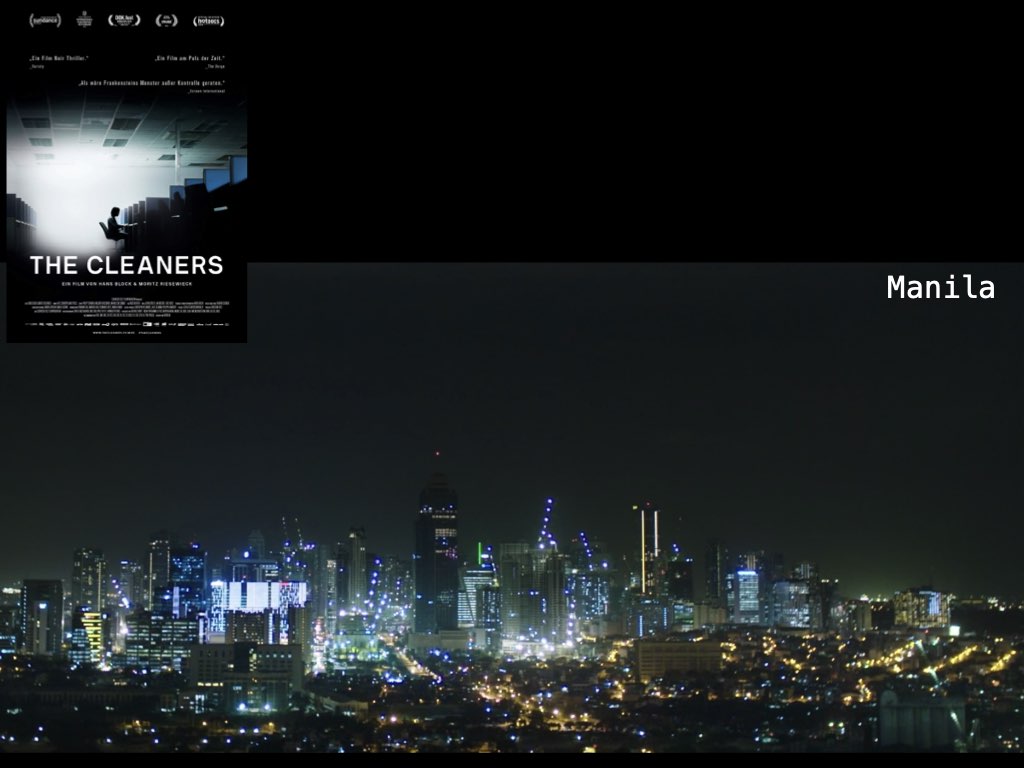
The Cleaners situates the people experiencing these working conditions within a gritty, cyberpunk version of Manila. The documentary presents views of the city like this one that make fairly obvious references to film noir and its sci-fi offshoots – it’s not hard to see Ridley Scott’s Blade Runner or William Gibson’s Neuromancer here.
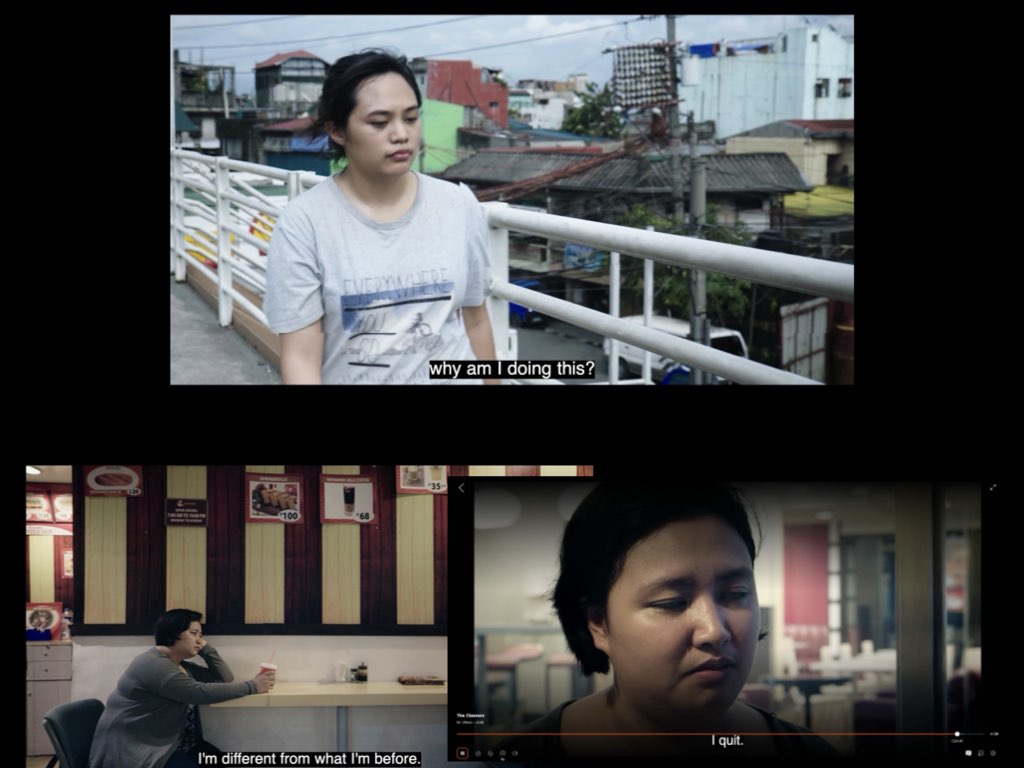
Within the first 15 minutes of the film audiences are directly introduced to content moderation work as cleaning up dirt and allusions to other forms of working with waste. Here, one of the women interviewed for the film tells a story as the camera tracks her walking through trash strewn streets. She describes how her mother always warned her about focusing on her education so that she wouldn’t end up being a “scavenger” since all they do is “pick up garbage”. In the course of the interviews with this unnamed, though obviously not anonymous, woman we are witness to a kind of journey as she narrates her transformation from someone initially excited about finding a job in an air-conditioned office in the ‘tech sector’ to her growing unease with her work as a content moderator due to the images she must watch over the course of a working day. Although, the film ends without clearly showing it, the filmmakers nevertheless strongly imply that eventually this woman finds the conditions of her work so disturbing that to quit and become a scavenger is actually a more appealing proposition.
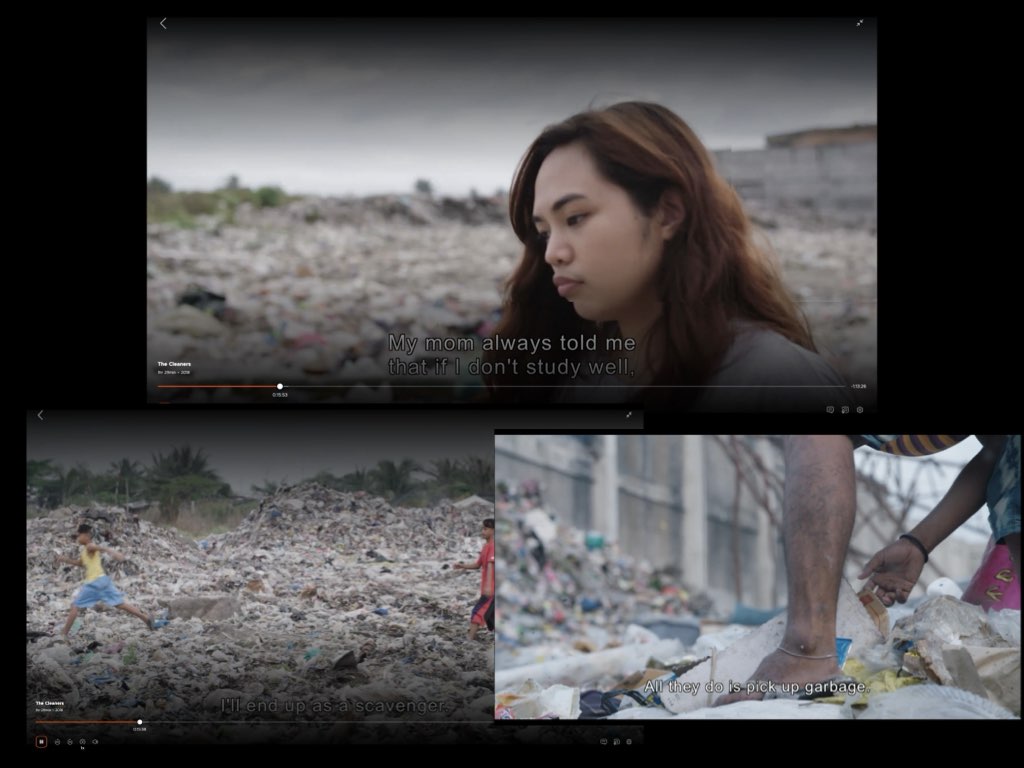
As the documentary continues, the filmmakers offer their audience additional evidence linking together the ideas of waste, dirt, and discarding with the work of content moderation.
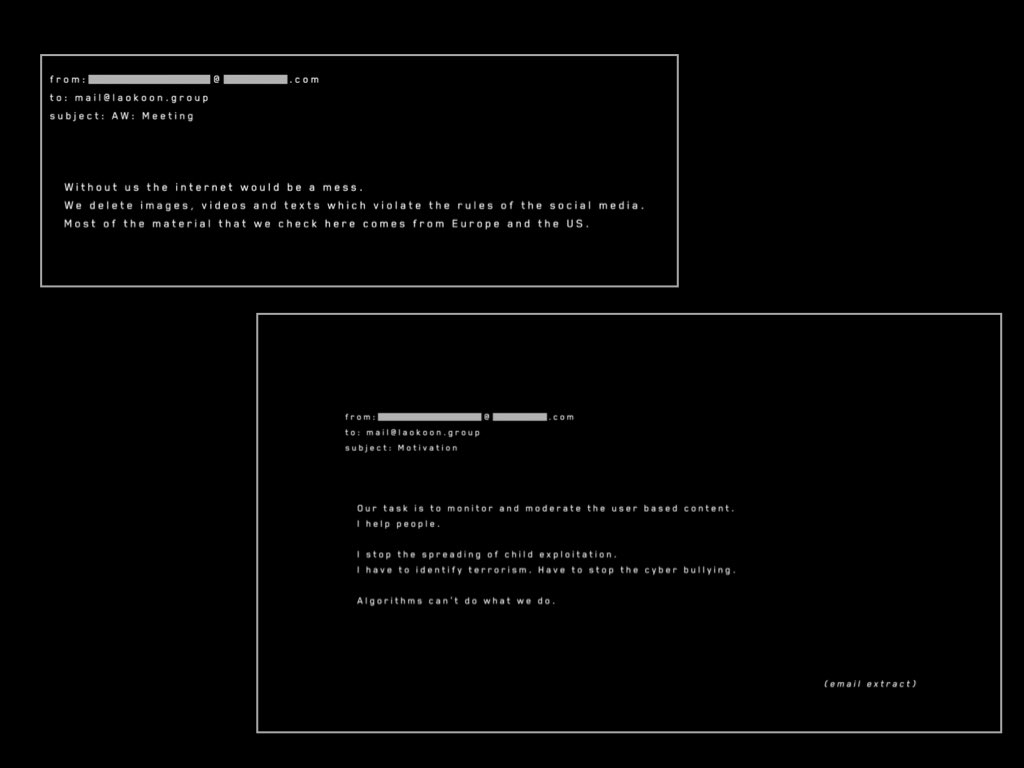
Here, excerpts from actual emails exchanged between the documentarians and content moderators help paint the picture. As one reads, “without us the Internet would be a mess. We delete images, videos, and texts, which violate the rules of the social media. Most of the material that we check here comes from Europe and the US.” Or in the second example, “our task is to monitor and moderate the user based content. I help people. I stop the spreading of child exploitation. I have to identify terrorism. Have to stop cyber bullying. Algorithms can’t do what we do.” There is much going on in these two short excerpts. They introduce us to real geographical linkages and distinctions between users of social media platforms and moderators, for example. They introduce us to a sense of moral mission that some moderators express even in the face of working conditions that perhaps you and I would find difficult to accept due to our own social positioning.
In response to the growing critical journalism and documentaries like The Cleaners social media platforms have disputed, for example, that they set quotas for content moderator decisions. Interviewees in the film tell a different story.
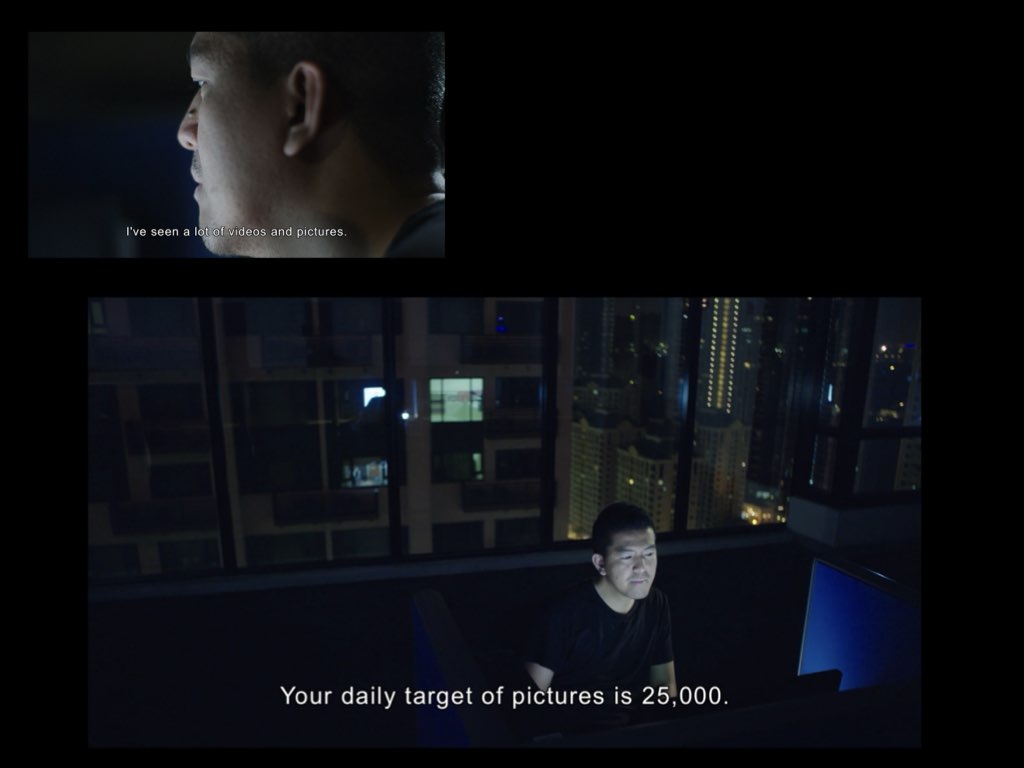
Now, consider what a daily target of 25,000 content moderation decisions could mean: assuming an eight hour working day that works out to a little over one second per image nonstop without breaks. To know the subtleties and nuances defining the criteria by which content should be deleted or ignored and to work at that pace is, arguably, highly skilled labor. As I mentioned earlier, at Facebook content moderation guidelines expanded from a one page document in 2008 to something exceeding 50 pages a few years later.
Content moderation has become highly specialized work over that time. It’s not just that a given moderator is making decisions on 25,000 pictures covering a random set of topics. Instead, the workflow funnels different categories of potentially objectionable content to moderators with the skill and knowledge to make those quick decisions on the content they have become domain experts about – free speech and hate speech, violence, and terrorism, sexuality, pornography, etc.
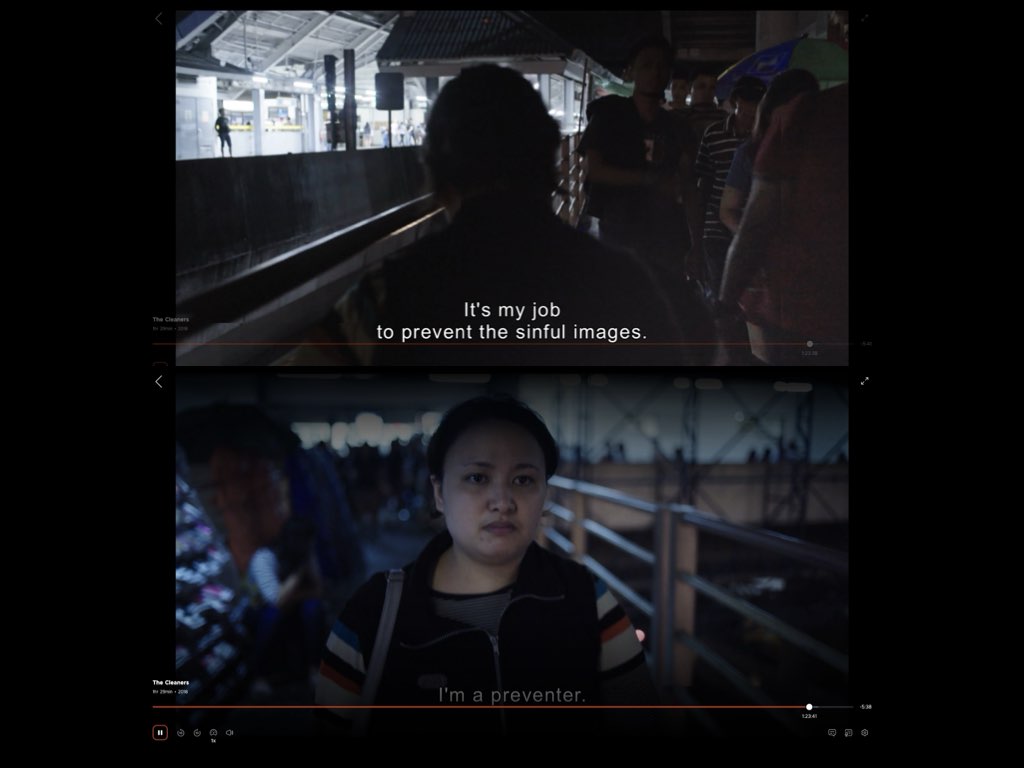
We watch another moderator in the film, discuss how she has had to learn all sorts of terms associated with sexuality and pornography in an American context so that she can complete her work here in the Philippines. The film depicts her as both a practicing Catholic as well as someone who admits to finding the content of her work simultaneously humorous, igniting her own erotic imagination, and sinful. She describes her work as a moral mission, calling herself a, “preventer”. By eliminating sexually explicit content from social media feeds, she’s eliminating the dirt, cleaning it up, but perhaps unsurprisingly such cleanup is never complete. Dirt has to go somewhere and it has to be dealt with by someone for a given system to maintain its order. That has consequences I will come back to momentarily.
Tolerance for error is minimal. Investigative journalists and scholars have shown that content moderators are required to maintain something like a 98 percent non-error rate. Those rates are determined by quality managers who review samples of moderated material and decide not just whether a given moderation decision was correct or incorrect, but whether it was so for the right reasons. As we watch The Cleaners we get a sense of this when a moderator writes, “I can skip those videos, but if the quality review figures it out, it is still marked as an error. I’m only allowed to make three errors in a whole month”.
By “those videos” the person writing this email is referring to having to review disturbing material – what specifically we are not told as watchers of the film. Nevertheless, the filmmakers use filmic techniques to great effect so as to convey how disturbing that material is without fully exposing viewers of their film to that material. Unlike the content moderators themselves, viewers of this documentary hear sounds associated with what content moderators are seeing on the screen as light flashes over their face. We, the viewers of The Cleaners, rarely directly see the content on the screens being moderated, and even then only in the briefest of flashes. Mostly, we witness the content moderators from above and behind their screen or in tight framing of the moderators in profile. These camera techniques are clearly deliberate choices on the part of the filmmakers and they heighten the emotional poignancy of the film as we viewers understand that we are deliberately not being exposed to disturbing content while the moderators are exposed to it constantly and directly as part of their work.
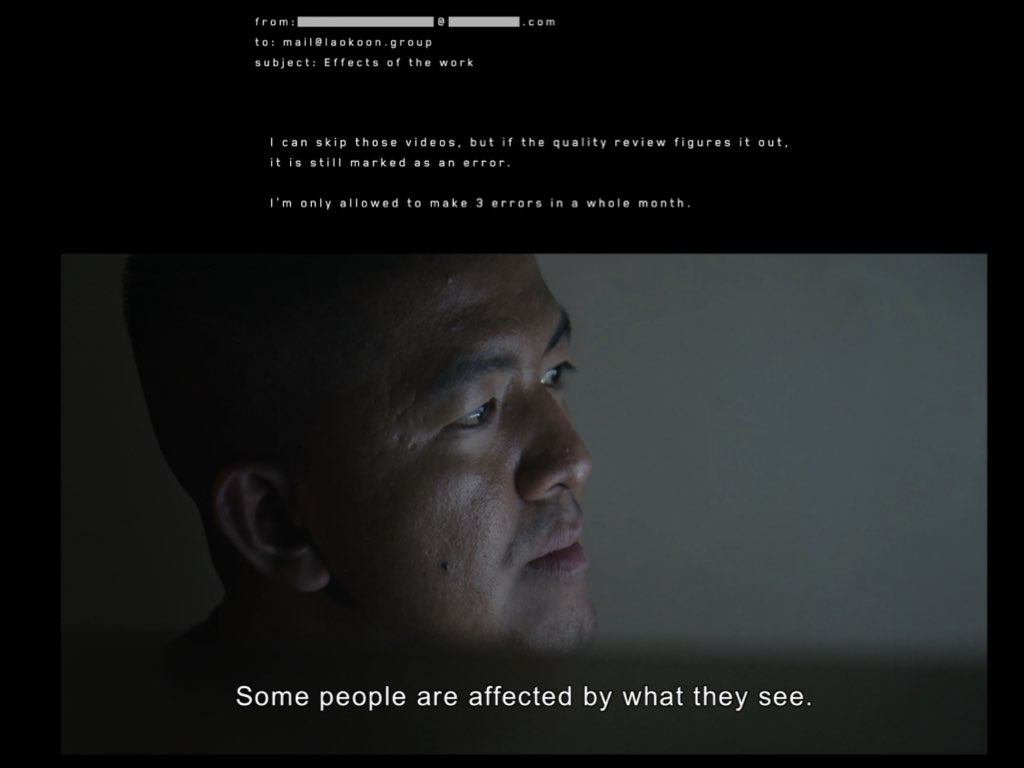
As this moderator says, “some people are affected by what they see.”
Cleaning up the dirt has consequences for people working as content moderators. Several discuss their decision to quit their jobs due to how disturbing they find the content they have to moderate. It’s not a stretch to think of their hearts, their minds, their psyches as the waste bins, the dumping grounds, the sacrifice zones to which content that is dirt to a given social media platform is being sequestered. Some who work in this industry may have, for whatever reason, some ability to sequester, assimilate, or eliminate such disturbing content without harms accruing to them. But there is substantial evidence that workers in the sector experience post-traumatic stress symptoms, up to and including self-harm and suicide.
A return to the “artificial intelligence pipeline”
As I’ve already mentioned, it can be difficult to draw a bright line between data work in the form of content, moderation and data work in the form of data labeling. Data labeling or data annotation is a critical phase of what some scholars call the artificial intelligence pipeline (Muldoon et al. 2024). Every step of the way along this pipeline requires skilled work by people to make often subtle and nuanced judgements about what to include or, said differently, assimilate into a given set of data and what to cull — or discard–from it. As we saw in the interviews and emails from content moderators depicted in The Cleaners, algorithms have limited abilities to perform this work.
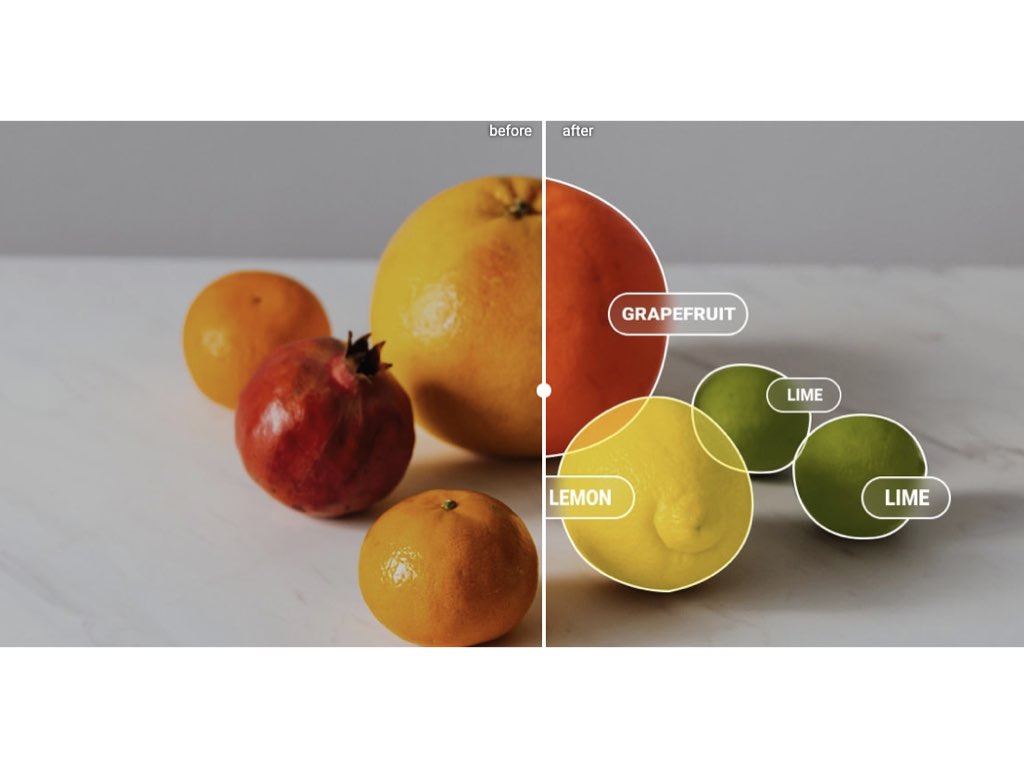
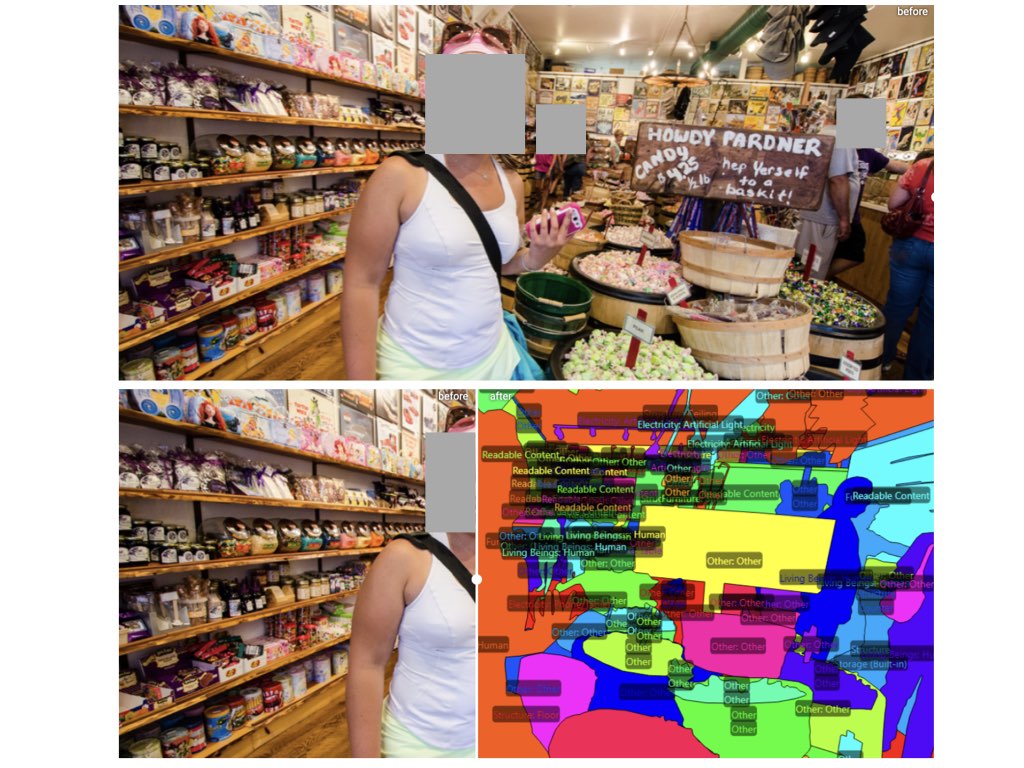
Data labelling may seem like a simple task, but it isn’t. While, the image on the screen might appear intuitive to colour-sighted human beings, there is in fact, rather a lot of complexity going on here. I am not a cognitive scientist, so I do not have the technical language to really get into that complexity, but the before/after images here hint at a good deal of subtlety and nuance in interpreting visual information that requires a combination of biology and embodied practice. Look for example at what is going on beyond labeling each of the coloured orbs on the right hand side of the screen. If you’re like me–colour sighted, Anglo-phonic–not only do I have the visual abilities to distinguish these orbs label them with particular sounds/words. I also have the practice of looking at flat photographic images and being able to interpret three-dimensions on a flat two-dimensional surface having learned what shadows, angles, and edges tell me about what is depicted in the image compared to my experience of moving through the world. On the ‘after’ side of the image, not only is labelling going on in the sense of adding names to fruit, but also defining edges that separate one orb from another. Data labellers are doing this work on thousands and thousands of images so that eventually a set of statistical rules – a.k.a. an algorithm – can use probabilistic math to make determinations about things like type of fruit, color, etc.
The details and specificity of knowledge required for data labelling increases as machine learning is deployed into more and more contexts. Here, the company advertising its services is showing its abilities in three-dimensional data annotation.

These services are being deployed into more and more situations, and, as this image might suggest, as various machine learning applications fade into the background of mundane life raise all sorts of questions around privacy…
… something highlighted to good effect in this mock advertisement for Meta’s new glasses. This ad is modelled on an actual advertisement you can find for the glasses, but it has been appropriated and remixed by privacy advocates. I’ll just note in the bottom right hand corner that the advocates are drawing attention to the the work of data annotators. As the text reads, “our dedicated human reviewers inspect your personal moments…”.

There are other stakes as well as machine learning is deployed into more and more fields. Here, an example image of data labelling in the service of self driving vehicles…

Data work extends beyond content moderation and data labelling to include remote operation of ‘driverless’ taxi services. Waymo, for example, has recently taken heat after it was revealed that what was billed as a self-driving fleet of vehicles actually required humans in the loop at all times. To be clear, remote operators are not driving the cars. But they are monitoring its video feeds and when automatic guidance systems fail, the remote drivers can maneuver the vehicle back to a situation where it can return to a self driving mode.
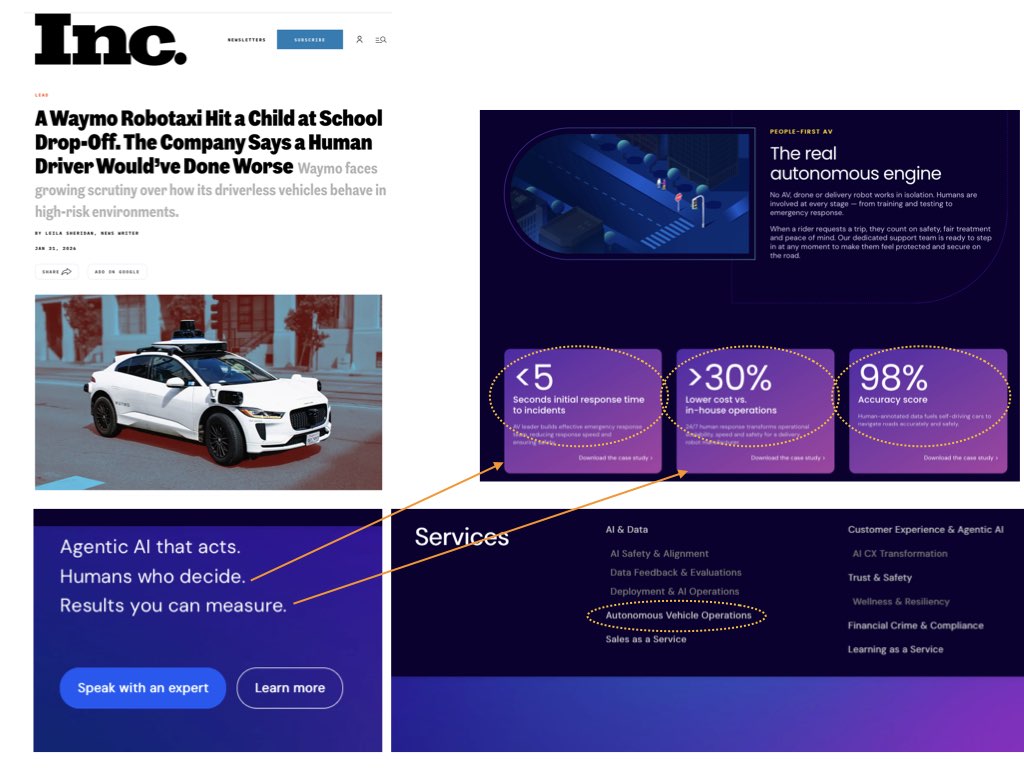
These screenshots from a company that provides outsourced data work, including data annotation, and remote operation of vehicles, highlights the productivity gains it can offer customers: less than five second response time, for example, if a vehicle enters into a situation that its automatic guidance systems cannot handle within their safety parameters; a greater than 30% cost savings compared to having these services in house; and a 98% accuracy score.
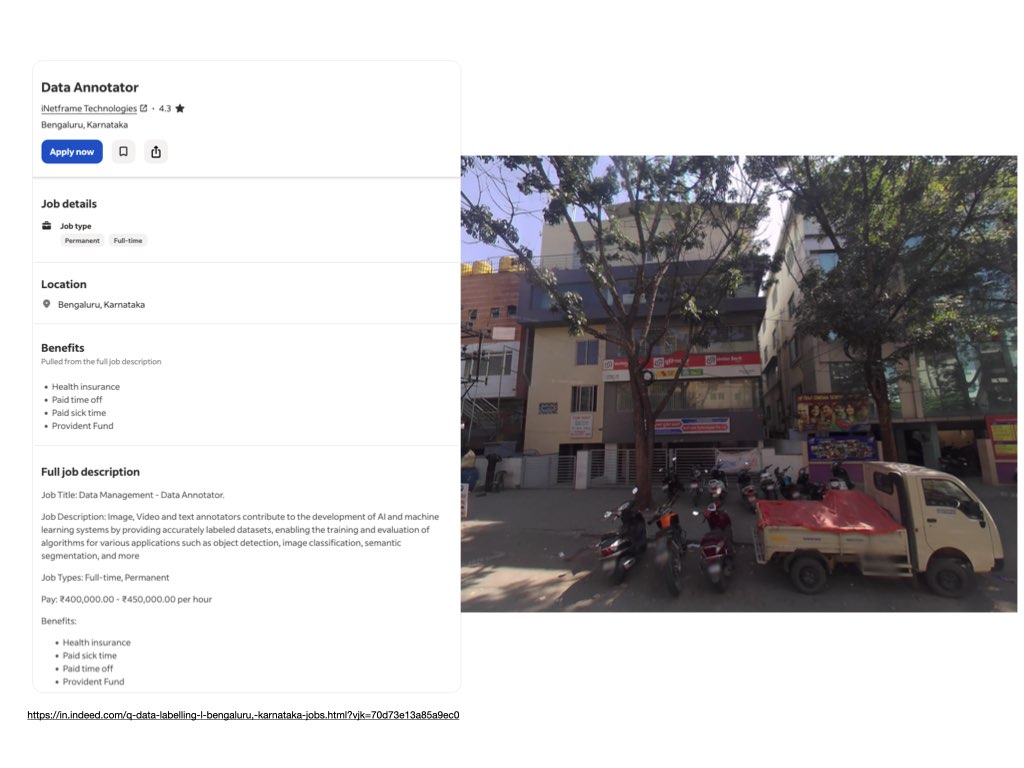
The work-a-day conditions in the data annotation sector can vary substantially from place to place. Here’s an example of an actual data annotation job advertised by accompany based in Bengaluru. You can see that positions like this can come with some decent benefits – health insurance, paid time off, paid sick time, etc. And the work might get done in small unglamorous offices like this one.
Humans in the Loop
Humans in the Loop takes the work-a-day conditions and routines of data labeling and uses them to tell a rich human story about several people, particularly women, navigating the complexity of their lives, including the power relationships that affect them, and their agency in asserting their own power within those broader conditions.

The film has been described as, “a social film that happens to be about AI” (Anjum 2025). The story centres on Nehma (played by Sonal Madhushankar) and her struggles to make a life for herself and her two children after the breakdown of her marriage and her return to her village in Jharkand. To maintain custody of her children she must have a job and, with the help of a friend, she manages to find one in the data annotation field in the capital city of Ranchi.
Along with the human dramas that make up the narrative, a central tension of the film is between what might be called place-based Indigenous knowledge and knowledge systems that presume their universality.
Nehma is depicted as an Adivasi woman of the Oraon tribe. In this early scene before she has actually been hired, she helps resolve a data annotation problem that two workers and the owner of the business are having trouble resolving. Sitting at the workstation, the two women working as data annotators are watching video clips of someone shopping in a grocery store. We see that person select different items from various shelves, and the two women are classifying each of those items. The person shopping moves into the produce section and selects something that is difficult for the women to categorize. The issue isn’t their lack of knowledge, so much as the quality of the video footage, which makes whatever is in the persons hand somewhat ambiguous. Is it turmeric or is it ginger root? From the back of the room Nehma makes a definitive call, impresses the boss, and gets a job. As viewers we experience Nehma’s ecological knowledge gleaned from her deep experience of the forest around her village brought into a data labelling context.
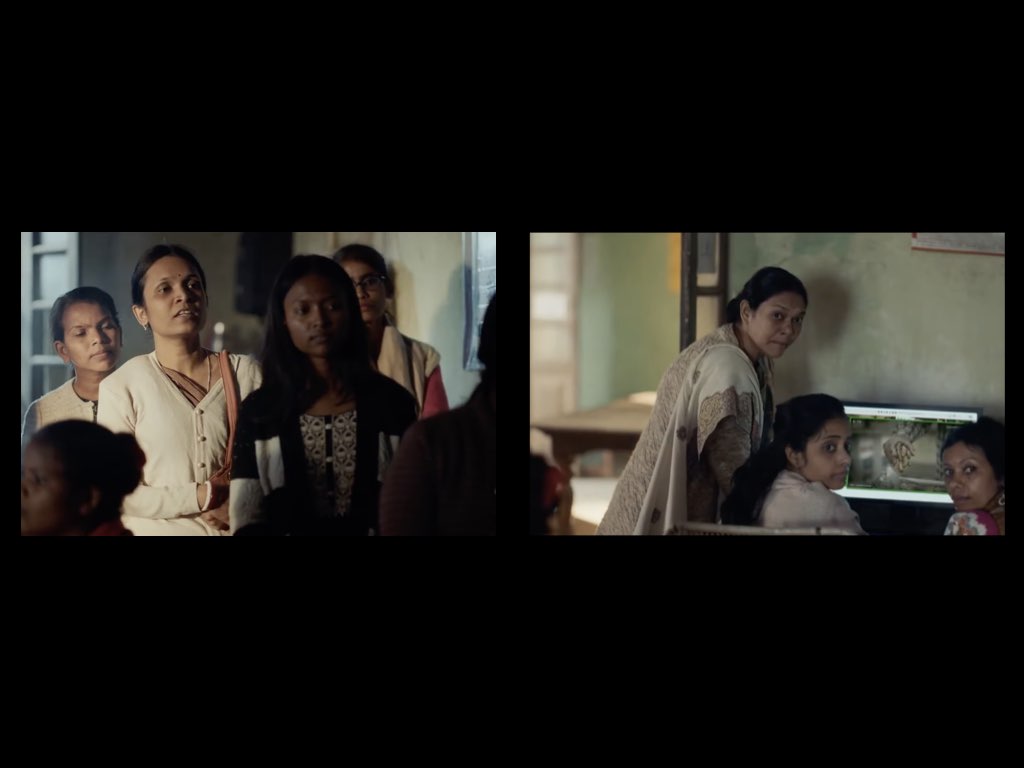
The film is subtle in some ways with this tension between different knowledge systems. Reviewing the film Nawiad Anjum writes, “the point is not that annotation is malicious, but that the grid itself is too coarse: when the world is forced into a handful of machine-readable boxes, nuance is the first casualty” (Anjum 2025).
It’s here that we can analyze data labelling through a discard studies lens. Here is Anjum again: “Humans in the Loop moves into the terrain of cultural erasure. Nehma and her colleagues are constantly nudged towards ‘clean’, ‘standardised’ labels that match the client’s expectations, even when those categories clash with local knowledge” (Anjum 2025). After working at her new job for some time, a new client from abroad contracts the firm Nehma is working for…
The new contract is data annotation for an artificial intelligence application in agriculture. Nehma is shown a training film. Part of it shows a video feed panning over a field as an automated crop seeding machine rolls over the ground. We see the video feed with example data annotations slide by quickly until an image of an insect appears. We have seen Nehma interact with this same species in the forest around her village where she is teaching her daughter about different plants and animals of the forest. Thanks to the depiction of that lesson, we the viewers already know that this insect eats only dead parts of leaves and dust helps the vegetation to thrive.
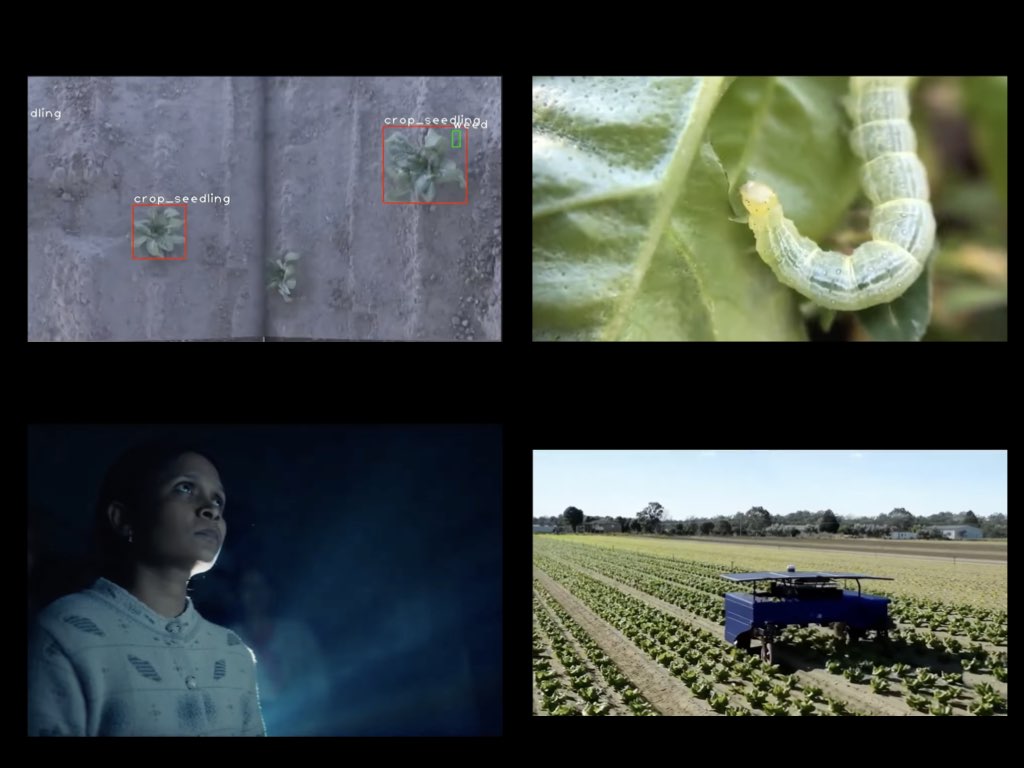
What Nehma learns in the training video, however, is that she must label this insect type a “pest” that the automated farming equipment will destroy with a laser. The sequence nicely illustrates some of the points I am trying to make about discarding. The ordering of a given system is maintained through discarding of some kind…
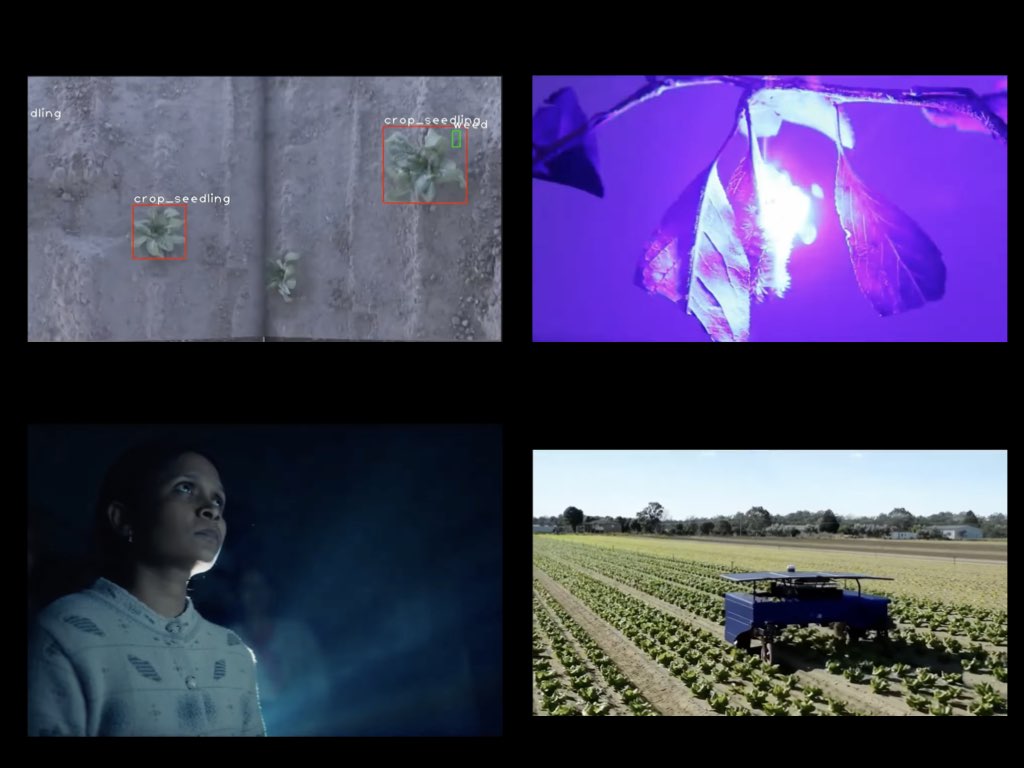
What is discarded may be sequestered, assimilated, or eliminated. Here, we see Nehma struggle with what she knows about the forest and its creatures against the system of categories being imposed upon them from outside. On the screen, her choices are constrained to four categories, none of which match what she knows through her lived experience. She knows these choices are wrong and faces a decision of her own. Taking her own knowledge as primary she deliberately miss-labels the data set. We can interpret that as a certain kind of power enacted through discard – she rejects, she gets rid of the categories she is confronted with. She almost loses her job for doing so. Symbolic systems and knowledge categories are at stake, yes, but the stakes can also be life and death.
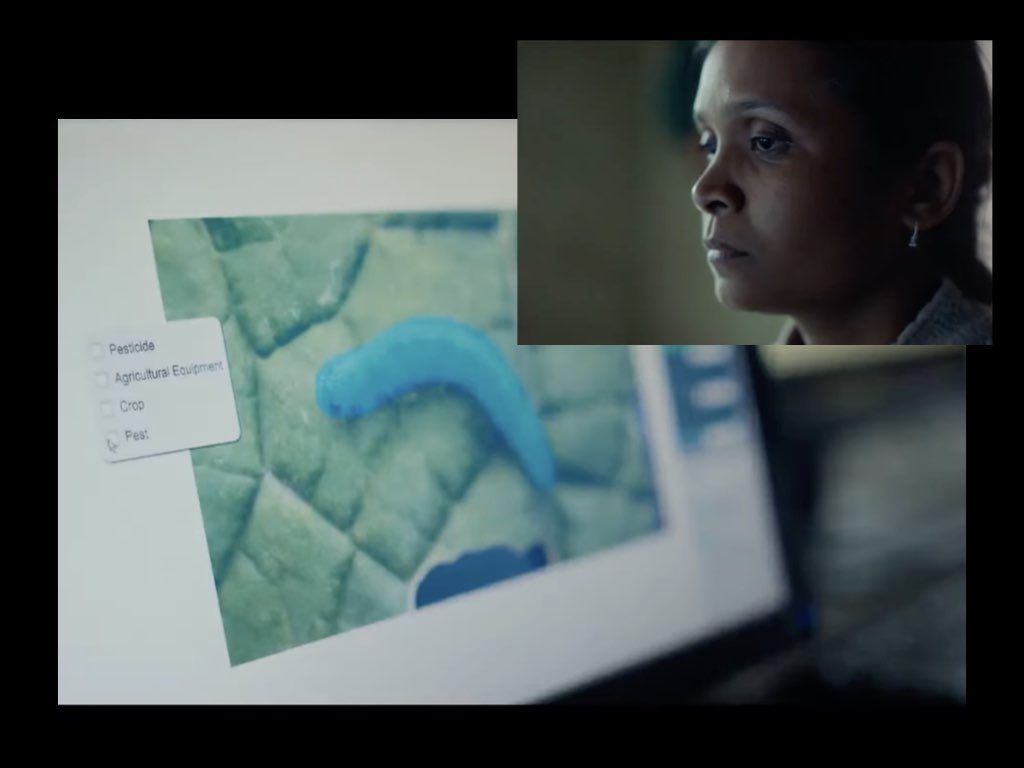
The portion of the training video Nehma watches that shows a high speed panning shot above the field with the labels “crop seeding” and plants outlined in red and “weed” outlined in green may seem relatively benign, depending on your point of view. Yet, though the film is not explicit on this point, it is impossible for me at least to watch the sequence and not see the obvious parallels with the use of technology like this in military targeting (for a discussion of the intimate links between the tech sector and the military see for example, Lécuyer 2007; Harris 2023). The annihilation of life in a biological sense, the annihilation of life in a cultural sense. These are the stakes of discard studies.
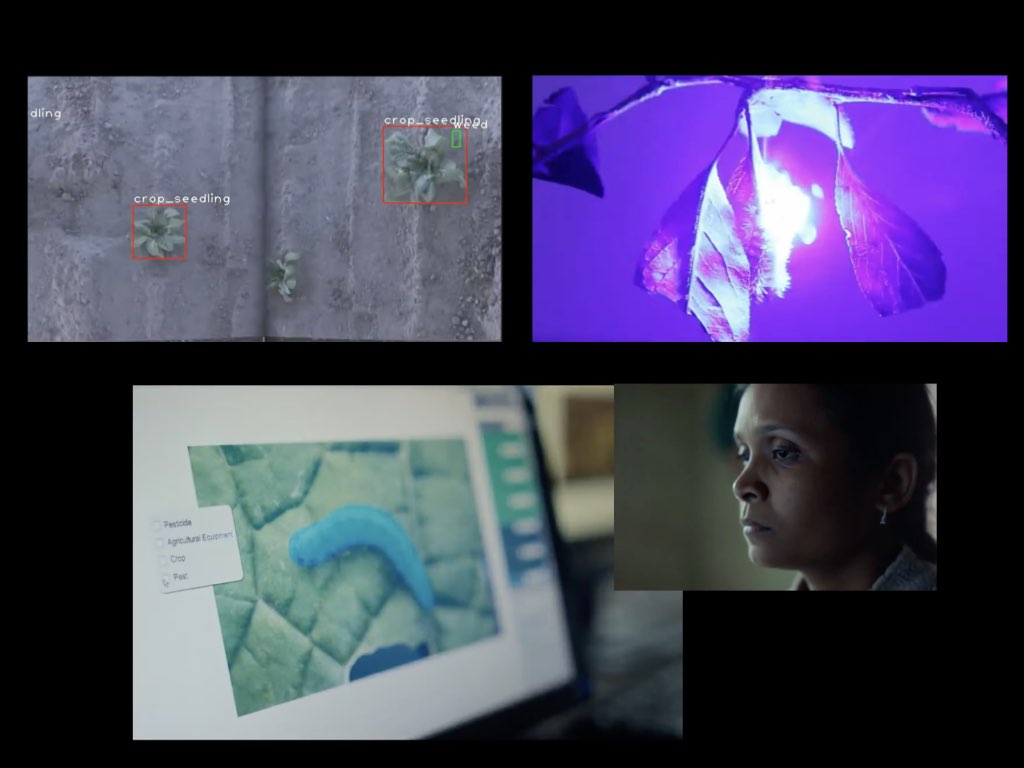
The situation being depicted in the film is a fictionalized version of real problems. The more a system, such as a knowledge system, presumes its universality the more tenuous its ordering becomes. As it encounters more and more of what doesn’t fit its presumptions, it must find more and more ways to discard that which does not fit so as to shore up its ordering. The consequences can be dire.
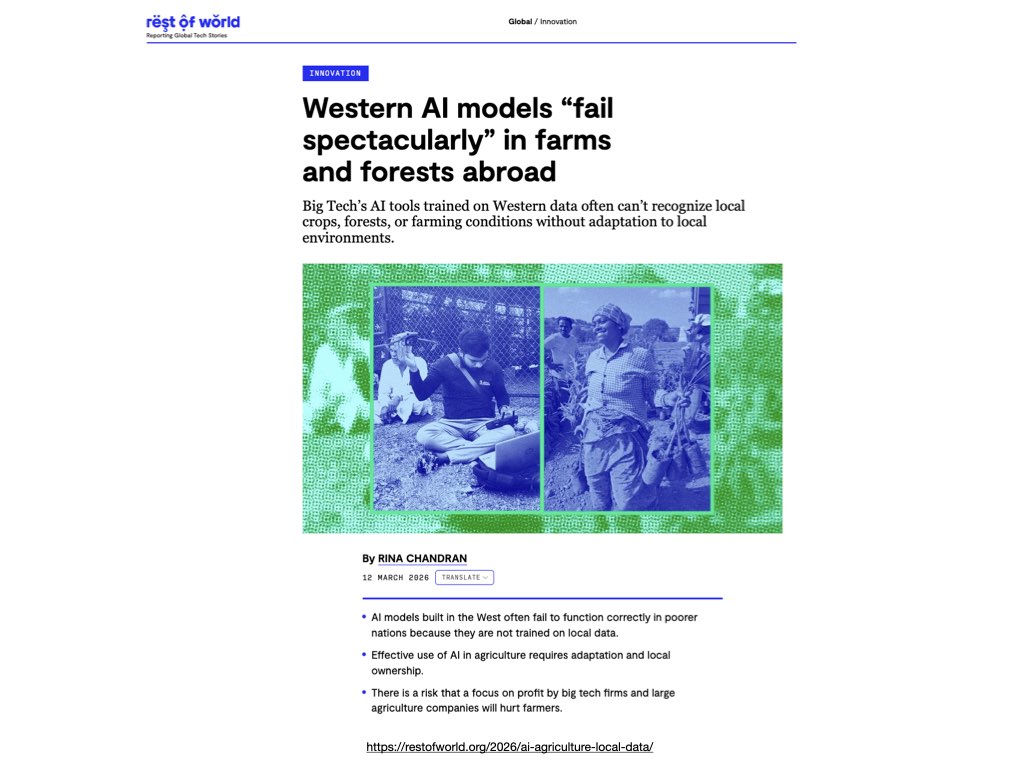
With Humans in the Loop viewers get a story where AI is normal technology and the human labour necessary for its operation is done by people living realistically human lives. They are neither downtrodden victims nor plucky heroes and they live in realistic places that are neither the problematic urban stereotypes of apocalyptic global south urbanism that Ananya Roy (2011) writes against (and which The Cleaners could be said to invoke), nor some romanticized rural village surrounded by verdant forest.
Or almost.
Humans in the Loop largely avoids the traps of what Roy (2011) calls ‘slumdog urbanism’. Yet, not withstanding the film’s rich social commentary on caste, class, gender, and technology, it does somewhat deflect broader criticism of the status quo.
An important part of the film shows. Nehma working with her employer and learning about how the underlying technology of machine learning works. An experiment between the two women ensues in which they prompt an AI image generator to create an image of a “beautiful tribal woman”. The resulting image is a pastiche of Indigenous iconography and ethnically indeterminate, though white-coded, beauty. Both women are disappointed by the results. They do not see themselves in the image.
Later, Nehma ‘solves’ the problem using images she downloads from her daughter’s phone. These are pictures taken in scenes around the village where they live and in a variety of every day settings…
We watch as Nehma solves the problem of representation by labelling the data from these downloaded images. We see the depiction of an animal on a village wall labelled “Indian, tribal, Sohai, art”, we see an image labelled “women, dress, saree, working” …
… we see a woman and child labelled “Indian, tribal, mother, child” and then the woman’s face labeled, “face, beautiful”. With the AI now trained on newly annotated data Nehma prompts the image generator again to show her a beautiful, tribal woman. In the resulting image, she can now see someone who looks like her.
Representation is not nothing. But this resolution in the film leaves broader and deeper questions about the status quo either unasked or the film suggests that there are technical solutions to these structural problems. In this sense, the film’s examination of the tensions between social ordering and technologies, such as artificial intelligence, resolves those tensions via techno solution-ism or, “a theory of change that posits that a social problem can be ‘solved’ deterministically by a technological design.” (Angel and Boyd 2024, 88; see also, Morozov 2013; Guthman 2024).
From data work to data workers
It is in the organizing activities of people who work in the data work sector that, I would argue, that offer the best examples of building up power to counter the negative aspects of the working conditions in this sector, rather than any kind of techno solution-ist approach to the harms arising in the sector. Workers are building organizations, including unions, to strengthen their bargaining positions and to ameliorate the negative aspects of their work. That organizing work is being supported and bolstered across borders by organizations like the Data Worker’s Inquiry – a community based research and advocacy team that includes credentialed scholars as well as workers themselves collecting data on the sector together.
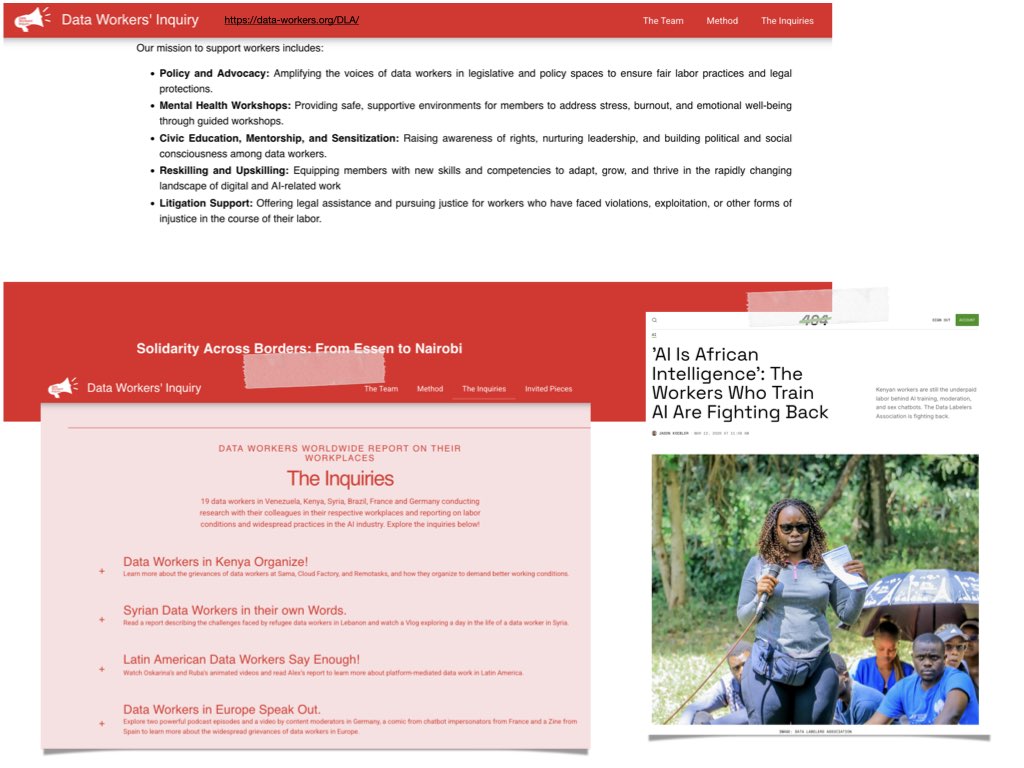
Workers organizing themselves for power is, of course, nothing new. But it is essential.
Conclusion
By way of conclusion, what I’ve tried to do today is draw some connections between key concepts in our research – waste, dirt, and discard. Through those connections I hoped to show how a discard studies approach helps those of us interested in “waste” and “work” might be able to think more expansively about what counts as waste and who counts as someone who works with it.
By considering the work of content moderation and data labeling –or what some call ghost work in the global south–I hope I have drawn useful connections between differently situated people, places, and things in a global politics of disposability.
I think the novelty of such work is debatable. But I hope that by framing this work through a discard studies lens I have added productively to the kind of approaches and concerns that those of us in this room bring to our own research on waste, work, and disposability.
My sincere, thanks for your invitation to be part of the symposium. I look forward to the discussions about to unfold…


You must be logged in to post a comment.