

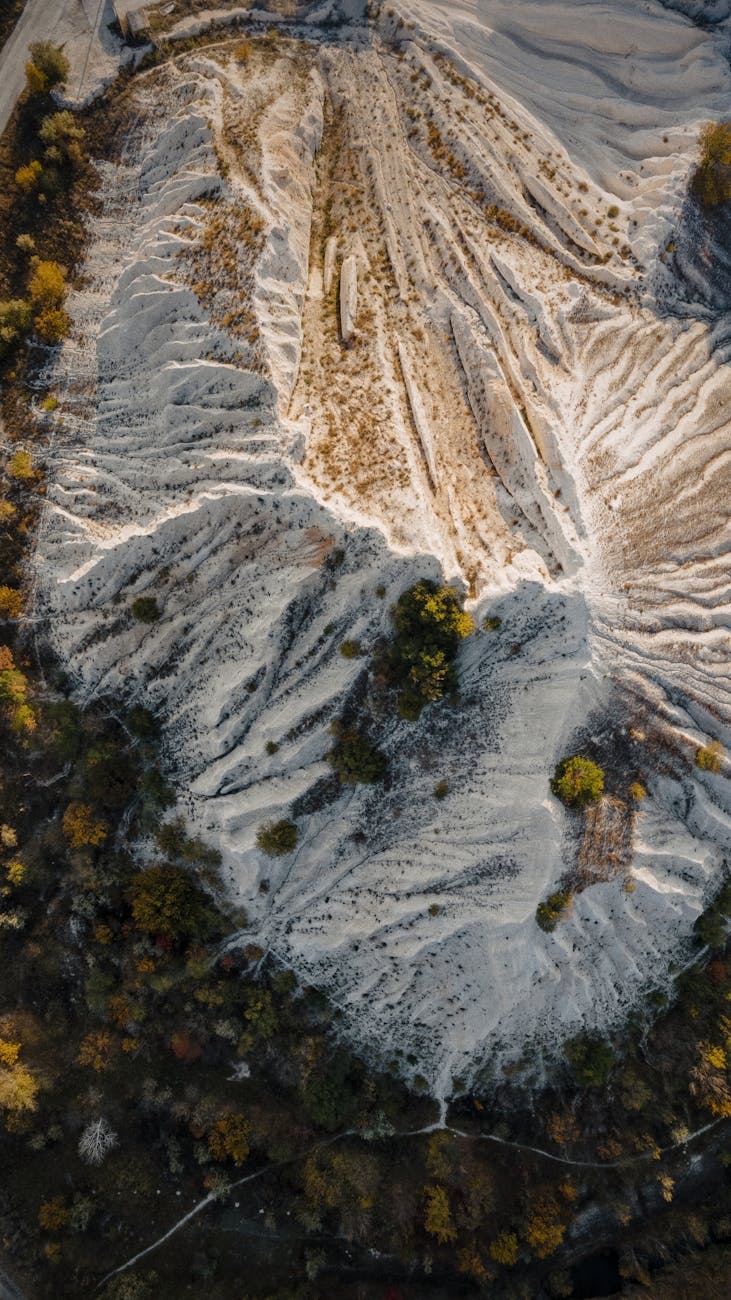
What is a sacrifice zone? At a basic level, a ‘sacrifice zone’ is a site deemed discardable. A lot is packed into that basic description. Who does the deeming? To whom? To what? Under what conditions?
Depending on context, the notion of sacrifice zone has multiple origins and meanings that trace back at least to the early 1970s in the Anglophone world. But on the morning of September 27, 2007 the term entered into the record of a US Senate hearing on reform to the Mining Act of 1872. New Mexico Senator, Jeff Bingham chaired the proceedings and opened the hearing at 9:35 AM. His remarks began by noting that attempts to reform of federal mining law had been going on “for decades” but that “[r]esults have been elusive” (“Hard-Rock Mining on Federal Lands” 2007, 1). Among the problems that reform efforts were concerned about was the ongoing “failure to collect any payment on hard rock mineral product from Federal lands” (“Hard-Rock Mining on Federal Lands” 2007, 1). Titles to mining rights on US Federal land can, to this day, be had for between $2.50 and five dollars per acre, literally the same nominal price paid in 1872 when the law was first passed. Besides the issue of missed revenue, reform of the Mining Law was needed to ensure mining operations “are conducted in an environmentally sound fashion” (“Hard-Rock Mining on Federal Lands” 2007, 1).
Several attachments accompany the hearing documents. One of those attachments is titled “FACT SHEET on Uranium Mining and Nuclear Pollution in the Upper Midwest” and sourced from a group called Defenders of the Black Hills (Charmaine White Face, n.d.). The document states that, in “1972, President Richard Nixon signed a secret Executive Order declaring this four State region to be a ‘National Sacrifice Area for the mining and production of uranium and nuclear energy.’” (Charmaine White Face, n.d.). in a recent paper on the genealogy of ‘sacrifice zones’ scholar Ryan Juskus (2023) also traces the emergence of the notion of a sacrifice area or zone to the era of the Nixon presidency and contemporaneous development of the concept by various Indigenous activists and theorists, including some directly involved in the American Indian Movement (AIM).
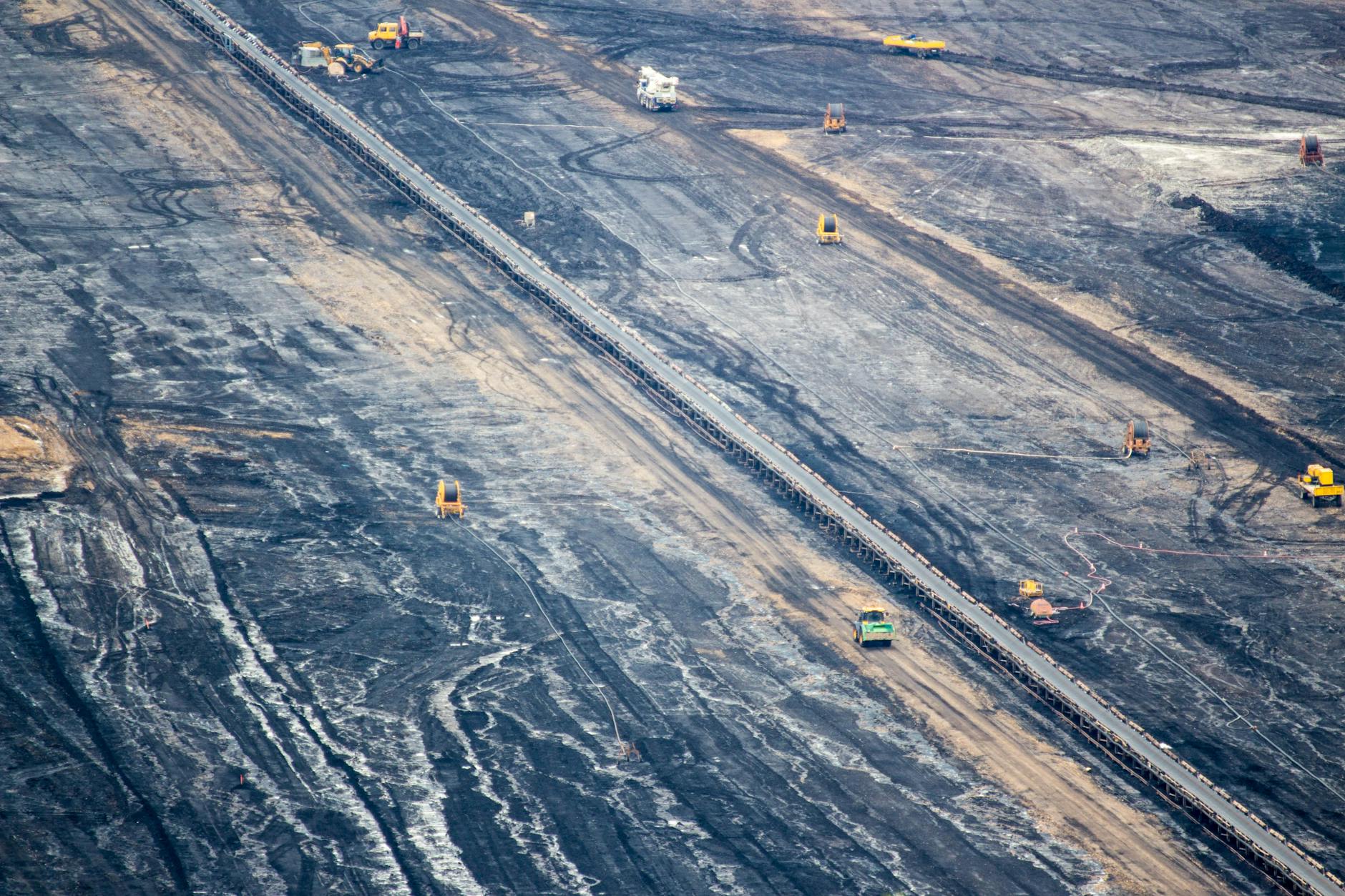
According to Juskus, the concept of a sacrifice area was in use by the 1970s in livestock management in the UK and the US. In those contexts a sacrifice area referred to the destruction of vegetation and other landscape features that tended to concentrate around key locations, such as water sources, in a larger area of livestock ranching. The notion of sacrifice areas or zones made its way from its agricultural origins to being a concept related to energy by 1973. A report from the National Research Council devoted to assessing the rehabilitation potential of land subject to coal mining referred to the possibility of such land being “declared national sacrifice areas” (National Research Council (U.S.). Study Committee on the Potential for Rehabilitating Lands Surface Mined for Coal in the Western United States 1974, 85). One reviewer of the report, Carl E. Bagge from the National Coal Association, was not impressed. In his assessment the idea of “national sacrifice areas” was “fuzzily defined” and “spurious” (National Research Council (U.S.). Study Committee on the Potential for Rehabilitating Lands Surface Mined for Coal in the Western United States 1974, 160, 163). In contrast, Ernst R. Habicht who was a staff scientist at the Environmental Defence Fund at the time, noted in his review of the report that if rehabilitation of land didn’t occur, then such land was likely to become a “national sacrifice area” (National Research Council (U.S.). Study Committee on the Potential for Rehabilitating Lands Surface Mined for Coal in the Western United States 1974, 183).
Clearly, the notion of a national sacrifice area or zone was circulating in the early 70s and in contexts associated with the Nixon presidency. So, I got curious. Did Richard Nixon sign a secret order in 1972 that declared parts of the United States national sacrifice zones? I contacted the national archives and here’s what I have been able to find out so far:
I started at the National Archives (also here, here, and here), trying to find either the original order from President Nixon or some reference to it. No luck. So I used the National Archive’s contact system for archivist assistance. An initial search did not turn anything up, but the archivist who answered my question pointed me toward the Nixon Library and its archivists.
The archivist at the Nixon Library was incredibly thorough and helpful. One thing they noted was that Executive Orders, “are, by their nature, public information”. So it is possible that there is a secret document about a directive made by President Nixon, but it would not technically be an Executive Order (as I understand it). Without my prompting, the archivist at the Nixon Library even consulted with their classified materials archivists. Nevertheless, they were ultimately unable to turn up a relevant document.
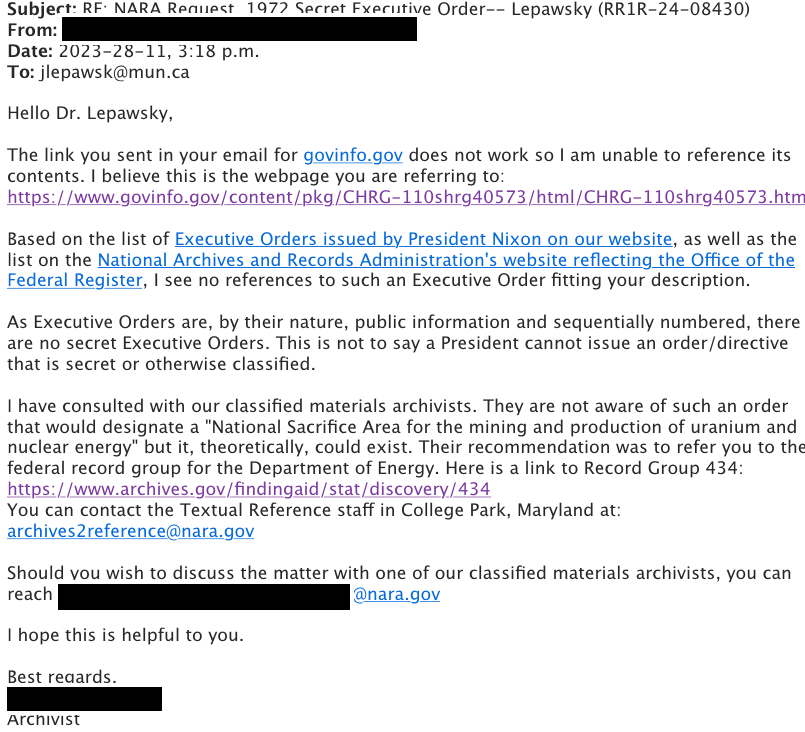
The Nixon Library archivist assisting me noted that such a document, “theoretically, could exist” and suggested contacting the federal record group for the Department of Energy. That suggestion was accompanied with the contact information for the Textual Reference staff at College Park, Maryland and a specific record group I might try. So I did.
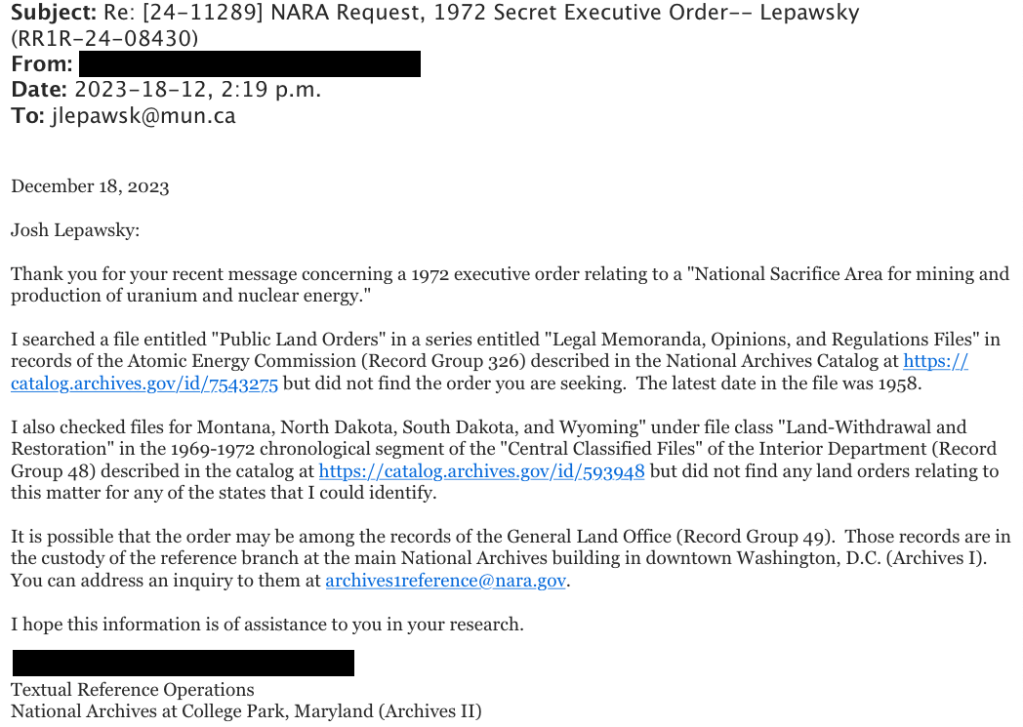
Archival staff at College Park provided me thorough help, but once again were unable to turn up a relevant document. Their suggestion was to check with records of the General Land Office (GLO) record group 49 at the main National Archives building in downtown Washington DC. Although I haven’t been able to travel to those archives, I was able to contact archivists there by email. They, too, were very helpful, but ultimately unsuccessful. According to the last archivist in this research chain I was in contact with, the Bureau of Land Management (BLM) and GLO (BLM’s predecssor) offices keep copies of Executive Orders between 1841 and 1952. The archivist went on to note that BLM retains custody of many records from the 1970s.
All of this is to say, it is possible that there is a document about a secret directive from President Nixon declaring portions of the US a national sacrifice area. But even if Nixon never made such a directive, secret or otherwise, the idea of a national sacrifice area or zone was definitely circulating in the broader discourse of the time.
If anyone has more information on the Nixon document I’d love to hear from you.
Works Cited
Bullard, Robert D. 2011. “Sacrifice Zones: The Front Lines of Toxic Chemical Exposure in the United States.” Environmental Health Perspectives 119 (6): A266.
Charmaine White Face. n.d. “Uranium Mining and Nuclear Pollution.” Defenders of the Black Hills. Accessed November 9, 2023. http://www.mining-law-reform.info/attach3.htm.
“Hard-Rock Mining on Federal Lands.” 2007. Washington, D.C. https://www.govinfo.gov/content/pkg/CHRG-110shrg40573/pdf/CHRG-110shrg40573.pdf.
Juskus, Ryan. 2023. “Sacrifice Zones: A Genealogy and Analysis of an Environmental Justice Concept.” Environmental Humanities 15 (1): 3–24. https://doi.org/10.1215/22011919-10216129.
Lerner, Steve. 2010. Sacrifice Zones: The Front Lines of Toxic Chemical Exposure in the United States. MIT Press.
National Research Council (U.S.). Study Committee on the Potential for Rehabilitating Lands Surface Mined for Coal in the Western United States. 1974. Rehabilitation Potential of Western Coal Lands; a Report to the Energy Policy Project of the Ford Foundation. Cambridge, Mass., Ballinger Pub. Co. http://archive.org/details/rehabilitationpo0000nati.


You must be logged in to post a comment.