
While in Berlin, Germany for HKW’s Participatory Planet project, myself and other participants visited an ALBA sorting facility on the east side of the city. The site sorts ~140,000 tonnes per year of waste metals, paper, and plastic sourced from Berlin’s municipal household recycling system.
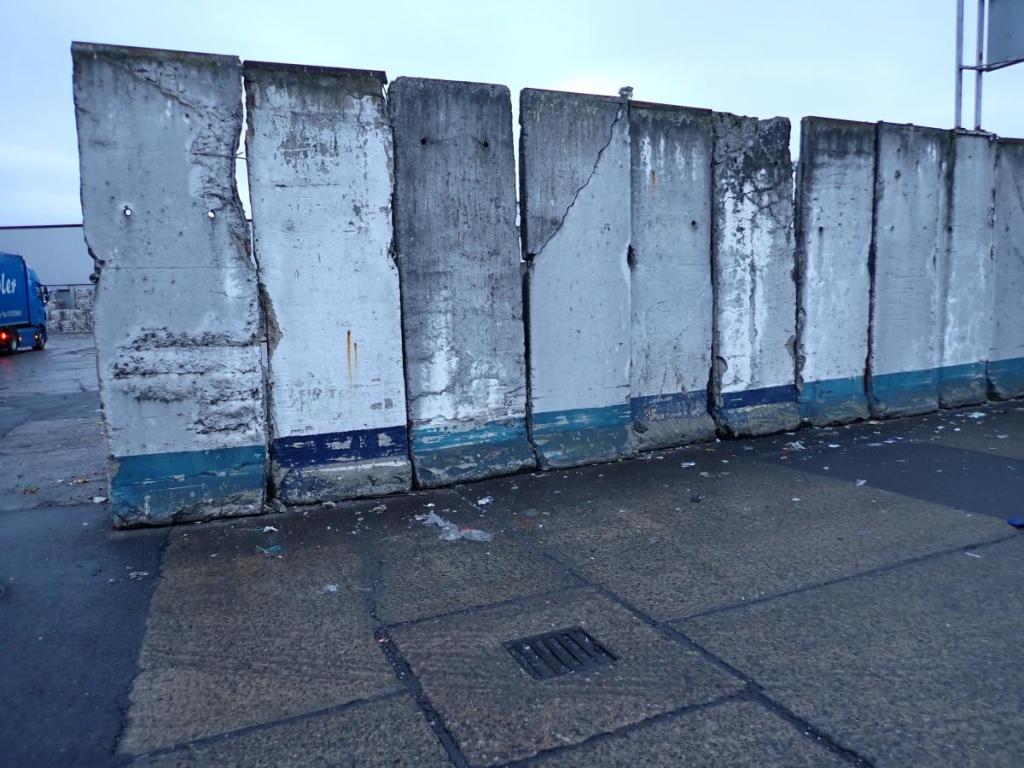
ALBA opened this site in the early 2000s at a location that had been East Berlin under the former communist government. Prior to opening this site, the company was contracted to deal with demolition waste from the Berlin Wall. Today, here, pieces of that former border wall organize containment of a different kind. A yard of sorted and baled plastics, metals, and paper. Semi-uniform blocks of all these sit stacked on one side of what was the Wall, waiting to cross the next gap separating waste from value.

There were some areas of the facility that we were not permitted to photograph. Inside a building where the mechanical and semi-automated sorting of materials takes place is the machinery of heavy industry. A massive front-end loader scoops mountains of materials from larger, smellier mountains, reaching up nearly one-story to dump its load into the maw that funnels all that material into the sorting system. That system is, at basic level, a series of conveyor belts and zones that separate different materials streams — paper, plastics, metals, and everything else — using a variety of mechanical techniques. Some involve blasts of air, coordinated by optical readers that separate lighter from heavier items. Others sort out ferrous and non-ferrous metals via magnetized separation. Somehow the sweetly sour odor of the mountain of unsorted material encountered earlier is barely noticeable in the crash of machinery as it sorts. The overwhelming sensation is noise, not smell (though it lingers). Here an industrial Rube Goldbergian system conveys and shunts and puffs and zaps away in roaring heat. Steel anti-slip floors and steps convey us along and up and through tunnels of dark grey-green and pale. Passageways of insufficient fluorescent light that, inevitably, flicker. Fugitive flotsam drifts in the air or is tuck, caught in this nook, that cranny. All edges of things accumulate a patina of dull, indeterminate grey, like dryer lint but slightly slick rather than dry. I imagine I can feel it starting to coat my insides, mouth to esophagus and on down to my lungs. Should I be worried? I can’t help but wonder.
Automation can only go so far. Black and dirty plastics confuse optical sensors. Wavelengths of light are scattered or do not reflect back to sensors in a way they can interpret. Even this system for sorting needs a route to discard that which does not fit. There are two such routes. One is people. Four employees stand at stations alongside constantly moving conveyor belts. One picks up things no machine can understand, makes a decision within two seconds, and tosses to this bin, that bin. Another person, her hands in nearly constant motion over a converyor belt, picks and flicks to bins without even having to turn her head to look for her intended target. Nothing misses. These people wear no safety equipment except for gloves. Eyes and hands coordinate a further sort into things that can be recovered and things that can’t. About 20 percent of what comes into this facility cannot be sorted into further materials recovery, so it is sorted out, discarded. That channel means a route to other sites for burial or incineration. Burial and incineration systems, too, have their discards: leachates, emissions. To be the systems they are, all systems must discard.

The machinic complex of conveyor belts, shredders, separators, optical sorters, in combination with the labour of people eventually produce bales of sorted materials that are ~95 percent ‘pure’. Pure here means ‘of the same type of material’– a bale of a particular type of plastic with 5 percent or less of other plastics, paper, metal or other materials. Less than 95 percent purity will mean the no buyers and onto the landfill or incineration. The buyers, separate companies, are the ones who will do the actual recycling after ALBA’s sorting. What we tour ends back in the bale yard, on the opposite side of the old Berlin Wall.

 Electronic Planet Research Lab
You must be logged in to post a comment.