
More electronic devices are manufactured than are purchased. Supply exceeds demand. That’s a problem for brands because a surplus of goods can lead to falling prices for them. To stop that from happening brands create scarcity. How? By finding ways to artificially limit supplies of goods already produced. One of the ways they do that is to destroy them. Take the following numbers from a study in the European Union by the European Environmental Bureau (an NGO): online retailers in the EU are estimated to destroy between €600 million and €3.1 billion (>$647 million to $3.4 billion US) worth of brand new electronics purchased online but returned (Rödig et al. 2021). Or, look at how Amazon and Apple do it. Back in 2019, Amazon and Apple entered into an agreement to de-list independent device refurbishers selling products on Amazon’s platform (RDKLInc, n.d.; Statt 2019). That practice reduced the supply of available used, repaired, and refurbished devices that might otherwise be sold. Apple also “forces recyclers to shred” iPhones and MacBooks, rather than refurbish, repair, and resell those devices (Koebler 2017). That means thousands of used, but useuable devices are simply destroyed, along with the conservation of energy and materials that occurs when existing devices are used for longer periods of time.
A lot of product destruction results from poorly designed incentives, including law–and laws are human creations and that means humans can change them. For example, in 1789 the US Congress passed regulations on what it called “drawback” (United States Customs and Border Protection 2013). ‘Drawbacks’ are refunds on customs duties, taxes, and fees paid when an importer brings products into the US. A refund of up to 99 percent of the dollar value of all duties, taxes, or fees can be recouped by the importer if the imported products are ultimately unused and destroyed under supervision of a customs officer. The explicit intent of the legislation under which drawback is permitted included things like job creation, encouraging manufacturing and encouraging exports. This legislation remains the law of the land in the US and, whether intentionally or not, also incentivizes the destruction of unsold yet perfectly useable products. Think of that. All the embodied energy and materials in brand new, perfectly useable but unsold products being deliberately destroyed so as to create scarcity and, thus, keep retail prices higher than they would otherwise be. It’s perverse. So what might be an alternative?
How about a library system for redistributing surplus products, like electronics? Libraries of Things are – ahem – already a thing. Here’s how this could work.
- Ok, to be frank about this: some people describe this kind of approach as library socialism – Gasp! – There. I said it (for short intros to ‘library socialism’ see here and here). Don’t like the idea of socialism? Fine. Call it something else — library economy, library infrastructure, library society. Those work, too. Also, even if you think you hate socialism, you’re probably already practicing aspects of it that you rely on heavily. Think of the last time you went poop. Your private act depends on a few metres of pipes in your home and then a vast network of collectively organized and paid for pipes called the sewer system. Or maybe you drive a car. Your use of a private vehicle depends on a massive network of collectively organized and paid for roads in order to get you from A to B. On the other hand, if you are an ideological purest and think that socialism only exists if and when all of the means of production are collectively owned and controlled by workers, the state, or some combination thereof, that’s fine. I’m just not interested in arguing over the proper meaning of the words ‘socialism’ or ‘capitalism’ (on those kinds of discussions, allow me to recommend Scott Sehon’s Socialism: a logical introduction (2024), a book that takes on arguments for and against capitalism and socialism in very approachable prose).
A library system system of provisioning personal electronics could be premised on certain principles.
Two characteristics are features of socialism: collective ownership of the instruments of production and democratic decision-making over output and surplus. The actual organization of those characteristics can take on a lot of different forms. Indeed, many examples already exist. The idea behind library socialism is to broadly institute those characteristics modelled on existing versions of actual libraries through three principles:
- Abolishing the right to destroy. Property law, as it exists under systems like English common law, has its origins in Roman slave society (Vulliez, 2023). Under the Roman system, property holders held the right to use (usus), to gather the surplus or profit (fructus), and the right to destroy (abusus). A library system of provision doesn’t necessarily do away with property rights per se, but it does get rid of the right to destroy. Rather than destroying surplus and, thus, needlessly wasting the embodied energy and materials of that constituting the surplus, the surplus can be re-distributed to those who need or want it. The annual surplus production of electronic devices can act as the source of electronics to be re-distributed to those who need and want them, rather than destroying those devices to artificially produce scarcity.
- Provision of an irreducible minimum for living a dignified life. Certain basics – – such as food, clothing, housing, healthcare, education, mobility, and communication – – are provided in ways other than private, profit seeking markets and of a quality that permits a sufficient, dignified quality of life for anyone alive. Here, “sufficient” is more than mere bare existence – – for example, more than access to just enough calories to avoid starvation. ‘Sufficiency’ means enough to flourish, to self-actualize, to enjoy. Electronics devices are increasingly integral to at least some of these basics, such as healthcare, education, mobility, and communication. Access to an irreducibly sufficient range of electronic devices is part of living a dignified life.
- Practicing an ethic of complementarity across difference. Although abstract, this principle basically comes down to naming the idea that shared positive benefits emerge when such things as different abilities, skills, knowledge and the like are brought together. An ethic of complementarity across difference exists even in situations involving competition. As Vulliez (2023) shows, complementarity across difference exists on a sports team. Goalies, forwards, wings, and defence players all do different things and all bring different skills to the field. Those differences, brought together, are what the team and its abilities emerge from. Open-source hardware and software are instances in the realm of electronics provisioning where this analogy of complementarity across difference in the form of a ‘team’ is already practiced.
The principles above can help organize the infrastructure and logistics of a library system of provision for personal electronics. Practical lessons can be gleaned from actually existing library systems. Although it doesn’t do justice to the meaning and value of ’library’, one way to think about them is as infrastructure for warehousing and distributing things, such as books. These are topics that operations researchers nerd out on all the time and there’s a vast specialist literature on them (van der Heide 2015). Some of the basic issues include planning, strategy, distribution, and logistics (Coleman 2024).
Inventories of devices for a library system of personal electronics can be derived from multiple sources. These can include household and business donations of used IT equipment, which is something that is already fairly common. To maximize the benefits of surplus devices that would otherwise be destroyed, however, the most important source would be manufacturers’ overproduction and retail overstock. Businesses devoted to collecting and reselling this kind of surplus already operate (e.g., here and here), so a library system of personal computing devices does not need to be invented out of thin air.
There are data on manufacturers’ overproduction and retail surplus. Remember that between €600 million and €3.1 billion of personal electronics were purchased online, returned, and destroyed in 2021 (Rödig et al. 2021). Those substantial figures refer only to retail returns from online purchases, not from manufacturer overproduction or from brick-and-mortar retail overstock. So the total amount of surplus goods made, only to be later unsold and destroyed is likely to be substantially higher. A study of the fashion industry, for example, claims that it produces about “150 billion garments a year, enough to supply 20 clothes for every person on earth” and of that production “[a]bout 30 percent of the worlds apparel is expected never to be sold” (“Manufacturing Platform for Apparel Industry | Fast & Sustainable – Fashinza,” n.d.). 30 percent is a lot of surplus per year (it doesn’t even account for the stock of surplus produced in previous years). Imagine if more (or all!) of it were circulated through a redistribution system incentivized to get it to people who need or want it, rather than artificially creating scarcity by dumping it in the Atacama desert (Shipley and Alarcón 2024).
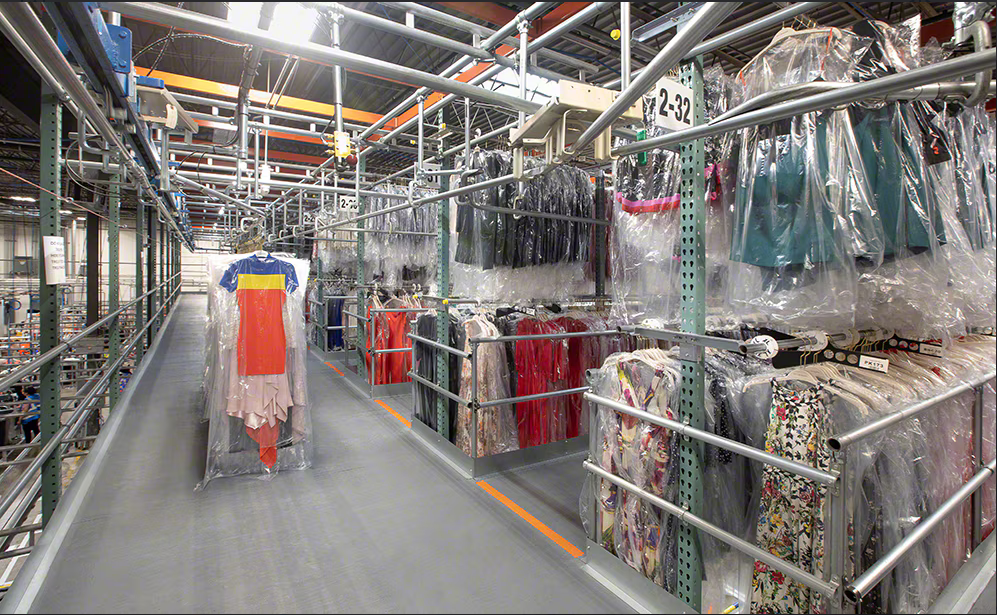
Industrial scale systems for renting high-end clothing already operate.
What’s more, manufacturers and retailers are themselves concerned about the destruction of such surplus. Even if they do it to artificially induce scarcity and maintain retail prices, such destruction is, at the very least, a negative hit to their bottom lines – – it is a cost that could otherwise be avoided. So, manufacturers and retailers are seriously concerned about overproduction (e.g., here, here, here, here, and here).
So what might an operational library system of personal electronics provision look like? Again, traditional book-lending libraries have already solved a lot of the distributional and logistical questions (James Coleman, (2024) a writer for Scope of Work, offers a helpful overview of these issues).
One issue is how best to manage stocks (or ‘collections’) of items. Depending on a variety of circumstances it may make sense to have a fixed collection or floating collection. Fixed collections, involve a single site that is ‘home’ to where a stock of devices are stored, distributed, and returned to. A fixed collection approach might work best, for example, in rural or remote communities where travel to other sufficiently populated locations involves long(er) distances.
Another approach is a floating collection. Essentially, floating collections permit lending of an item from one library location and return of that item to a different location. This approach can cut labour and transportation costs by foregoing the necessity to return the item to the original site from which it was lent. Floating inventories might work better in suburban and urban locations where the density of device users are higher. The point here is that these various approaches to distribution and logistics do not need to be reinvented for a library system of electronics provision because they already exist.
- Sidenote: Coleman (2024) points to a fascinating example: Netflix’s original operations as a circulator of physical DVDs (see also Horowitz 2009). The Netflix example is instructive in a couple of ways. One, it shows that lending library systems of distribution are not radical departure’s from traditional capitalist business models. As such, they provide models for ‘starting where ‘we’ are’ rather than waiting for an ever receding event horizon of a ‘radical break’. The case of Netflix also shows that it is quite possible for an organization to shift from one system of distribution and service delivery to another and remain viable. As a further aside, there’s a very interesting set of questions here about the before and after environmental footprint of Netflix having transformed itself from the physical circulation of DVDs to a streaming service. Such streaming services sometimes get flack for their energy and material requirements associated with running servers. They also get flack for the seeming inefficiency that is built into the streaming model i.e., instead of downloading a movie once, storing it locally, and thus being able to watch it again without re-downloading, streaming services rely on the repeated movement of information in order to rewatch content. I’m curious whether it is possible to provide a before and after snapshot of operations like Netflix in terms of their environmental footprint. How does the company’s footprint as a digital streaming service compare to its former operation as a warehousing and distribution system of physical DVDs? If anyone knows of any research out there please point me to it.
In a library system for provisioning personal electronics there would, of course, need to be consideration of factors that go beyond traditional book lending. Length of lending times, for example, could be open ended rather than fixed. Again, the issue is not the scarcity of devices–surpluses are produced annually. Instead of scarcity, the issue is how to equitably distribute this abundance that already exist (maybe as such a system develops it becomes the case that there are truly not enough devices of the right type for everyone who needs and wants them, but with the surplus of devices that are already produced, that horizon of scarcity would seem to be a future problem and, as such, one for which solutions can be worked out democratically).
Data storage, privacy, and the like would also be important issues. But again, a lot of more or less working solutions already exist. For example, it is already common under extant systems of electronics provision to trade in devices after specified period of time (months or years), often long before devices have reached hard limits to their operability. Ways of dealing with personal data retention and erasure already exists within those systems. It’s not hard to imagine bringing back a device–a phone, a laptop–to a library-esque site and having access to trusted open source hardware and software for retaining your personal information and wiping it from advice you are about to exchange for another one. Such a library-like space could also cater to all kinds of other electronic device related needs such as repair and refurbishment e.g., by providing access to tools and personal expertise. Again, these kinds of library spaces already exist and if they exist, it is possible to proliferate their possibilities.
Conclusion
As Sam, a friendly member of Usufruct Commons, once wrote to me, ‘Nothing about the future is obvious; we’re still inventing it as we go.’ No doubt there are details and difficulties I haven’t thought of in this suggestion for an alternative. But just because something might be tricky or difficult are not reasons to avoid trying them. Also, there’s the issue of getting from where things are, to where people might want them to be. There is no starting from a better place; there’s only starting from where we are and doing the work to build the alternatives people might want. Conventional libraries are already existing infrastructure, familiar to and enjoyed by many.
It is already common for conventional libraries to lend things well beyond conventional books, including electronic devices among many other things. These kinds of extant systems for lending could be expanded. Support for that expansion could come from the surplus brands already produce but deliberately destroy in their pursuit of profit.
A library based system of provision for electronics would mostly rely on ways of organizing device provision that already exist but organize them in different ways, based on different principles, and to different ends from the status quo. A library approach would manage surplus through redistribution. A transition to such a re-distribution system could be better incentivized even under existing, predominantly profit oriented systems by, for example, modifying existing tax policy and other forms of regulation.
Principles of a library socialist approach to device provision – usufruct, irreducible sufficiency, and complementarity – could be used to design such systems of provision and achieve a variety of social and environmental benefits (e.g., equitable access to digital devices; reduced environmental harms). Overproduction of devices already occurs. In that sense, surplus abundance already exists. Much of the necessary infrastructure for (re)distribution already exists. Public libraries provide a model to imagine with. Re-organizing and extending what already exists toward different ends may not always be easy, but it can be done. To paraphrase two related points attributed to heterodox economists Kenneth Boulding (1978, 51) and Elinor Ostrom (Fennell 2011, 10), if it exists, then it is possible; and if it can work in practice, it can work in theory.
Works Cited
Boulding, Kenneth E. 1978. Stable Peace. University of Texas Press.
Coleman, James. 2024. “Notes On Libraries.” Scope of Work. June 10, 2024. https://www.scopeofwork.net/notes-on-libraries/.
Crawford, Kate, and Vladan Joler. n.d. “Anatomy of an AI System.” Anatomy of an AI System. Accessed September 10, 2018. http://www.anatomyof.ai.
Elia, Ariele. 2020. “Fashion’s Destruction of Unsold Goods: Responsible Solutions for an Environmentally Conscious Future.” Fordham Intellectual Property, Media and Entertainment Law Journal 30 (2): 539.
Fennell, Lee. 2011. “Ostrom’s Law: Property Rights in the Commons.” International Journal of the Commons 5 (1). https://doi.org/10.18352/ijc.252.
Heide, Gerlach van der. 2015. “Inventory Control for Multi-Location Rental Systems.” PhD, Groningen: University of Groningen. https://pure.rug.nl/ws/portalfiles/portal/27775735/Complete_thesis.pdf?ref=scopeofwork.net.
Horowitz, Etan. 2009. “Netflix Distribution Centers: A Portrait of Speed and Efficiency.” The Seattle Times. August 20, 2009. https://www.seattletimes.com/business/netflix-distribution-centers-a-portrait-of-speed-and-efficiency/.
“How Would a Library Economy Be Implemented on the Internet Side of Things (e.g., Streaming Services, Social Media, Etc.)? – General.” n.d. Usufruct Commons. Accessed October 26, 2024. https://librarysocialism.com/t/how-would-a-library-economy-be-implemented-on-the-internet-side-of-things-e-g-streaming-services-social-media-etc/779/7.
Koebler, Jason. 2017. “Apple Forces Recyclers to Shred All iPhones and MacBooks.” Motherboard. April 20, 2017. https://motherboard.vice.com/en_us/article/apple-recycling-iphones-macbooks.
Kostakis, Vasilis, Vasilis Niaros, George Dafermos, and Michel Bauwens. 2015. “Design Global, Manufacture Local: Exploring the Contours of an Emerging Productive Model.” Futures 73 (October):126–35. https://doi.org/10.1016/j.futures.2015.09.001.
“Manufacturing Platform for Apparel Industry | Fast & Sustainable – Fashinza.” n.d. Accessed October 28, 2024. https://fashinza.com/fashion-designs/design-trends/a-report-on-overproduction-in-the-apparel-industry/.
RDKLInc. n.d. “Apple, Amazon, and the Shrinking Internet Landscape.” RDKL Inc. Accessed November 22, 2018. https://www.rdklinc.com/blog/2018/11/apple-amazon-and-the-shrinking-internet-landscape.
Roberts, Hedda, Leonidas Milios, Oksana Mont, and Carl Dalhammar. 2023. “Product Destruction: Exploring Unsustainable Production-Consumption Systems and Appropriate Policy Responses.” Sustainable Production and Consumption 35 (January):300–312. https://doi.org/10.1016/j.spc.2022.11.009.
Rödig, Lisa, Dirk Jepsen, Till Zimmermann, Robin Memelink, and Anna Falkenstein. 2021. “Policy Brief on Prohibiting the Destruction of Unsold Goods.” Brussels: European Environmental Bureau | Institut für Ökologie und Politik GmbH.
Sehon, Scott Robert. 2024. Socialism: A Logical Introduction. Oxford Scholarship Online. New York, NY: Oxford University Press. https://doi.org/10.1093/oso/9780197753330.001.0001.
Shipley, Julia and Muriel Alarcón. 2024. “A Mountain of Used Clothes Appeared in Chile’s Desert. Then It Went Up in Flames.” Wired, January 13, 2024. https://www.wired.com/story/fashion-disposal-environment/.
Statt, Nick. 2019. “How Apple’s Deal with Amazon Screwed over Small Recycling Businesses.” The Verge. May 21, 2019. https://www.theverge.com/2019/5/21/18624846/amazon-marketplace-apple-deal-iphones-mac-third-party-sellers-john-bumstead.
United States Customs and Border Protection. 2013. “Drawback | A Refund for Certain Exports.” https://www.cbp.gov/sites/default/files/assets/documents/2016-Dec/Drawback_refund_2%2812-16-2016%29_0.pdf.
Vulliez, Shawn. 2023a. “Cooperative Difference.” Medium (blog). September 29, 2023. https://medium.com/@wrong_shon/cooperative-difference-bb1db8256381.
———. 2023b. “The Basics of Library Socialism V0.3.” Medium (blog). November 5, 2023. https://medium.com/@wrong_shon/the-basics-of-library-socialism-wip-1c3f00a7c94f.
 Electronic Planet Research Lab
You must be logged in to post a comment.